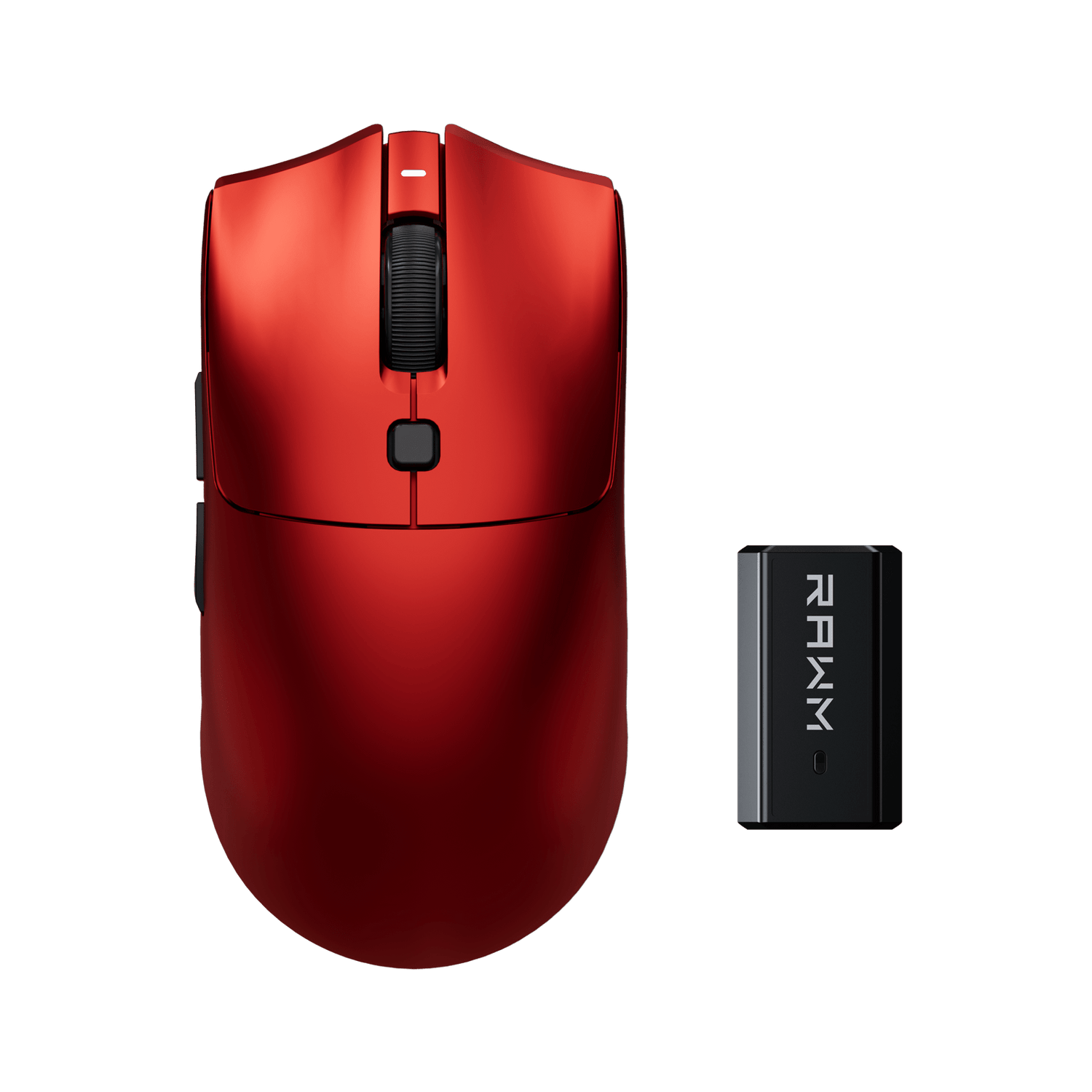
Gaming Mouse Sensor Explained (2026): Everything You Need to Know About Gaming Mouse Sensors
When shopping for a gaming mouse, it's easy to be overwhelmed by technical specifications.
Manufacturers promote features like PixArt 3950, 30,000 DPI, 650 IPS, 50G acceleration, Motion Sync, and 8K polling rate, making it seem as though the mouse with the biggest numbers is automatically the best choice.
In reality, that's rarely how gaming performance works.
A modern gaming mouse sensor is responsible for translating every movement of your hand into precise on-screen actions. While the sensor is one of the most important components inside a mouse, it's only part of a much larger system. Firmware optimization, lift-off distance, tracking stability, surface compatibility, latency, and overall mouse design all contribute to how a mouse actually feels during gameplay.
That's why two gaming mice with similar sensor specifications can deliver completely different experiences.
This guide explains what gaming mouse sensors actually do, how modern optical sensors work, which specifications genuinely matter, and how to separate meaningful performance improvements from marketing claims.
Whether you're buying your first gaming mouse or deciding between flagship models, understanding the sensor inside your mouse will help you make a far more informed decision.
By the end of this guide, you'll understand:
- How modern gaming mouse sensors track movement
- The difference between optical and laser sensors
- Which sensor specifications actually matter
- How premium sensors compare in real-world gaming
- How to choose the right sensor for your favorite games
Table of Contents
- What Is a Gaming Mouse Sensor?
- Optical vs. Laser Sensors: What's the Difference?
- Which Gaming Mouse Sensor Specifications Actually Matter?
- Popular Gaming Mouse Sensors Compared
- Does Sensor Quality Really Affect Gaming Performance?
- How to Choose the Right Gaming Mouse Sensor
- Frequently Asked Questions
- Key Takeaways

Chapter 1: What Is a Gaming Mouse Sensor?
Every movement you make with your mouse begins with one tiny component—the sensor.
It's often described as the "heart" of a gaming mouse because it constantly measures your hand movement and converts it into cursor movement on your screen. Without a reliable sensor, even the most comfortable mouse shape or the fastest switches can't deliver consistent performance.
Unlike older mechanical mice that relied on a rolling ball to detect movement, today's gaming mice use advanced imaging technology to monitor the surface beneath the mouse thousands of times every second.
The sensor doesn't know whether you're playing Counter-Strike 2, editing photos, or browsing the web. Its only job is to answer one question as accurately as possible:
"How far, how fast, and in which direction did the mouse move?"
The more accurately it answers that question, the more natural and predictable your mouse feels.
How Does a Gaming Mouse Sensor Work?

Modern gaming mice primarily use optical sensors, which function like an extremely high-speed camera.
Instead of physically measuring movement, the sensor continuously captures microscopic images of your mouse pad while an onboard processor compares one image with the next.
From these comparisons, the mouse calculates:
- Movement direction
- Distance traveled
- Movement speed
- Cursor output
This process happens thousands of times every second, allowing the cursor to respond almost instantly as you move the mouse.
Although the technology is incredibly sophisticated, the goal is surprisingly simple: reproduce your hand movement on screen as accurately as possible.
Why the Sensor Matters in Gaming
A high-quality sensor doesn't make you aim better overnight—but it ensures that your mouse responds exactly the way you expect.
That's especially important in competitive games where small inaccuracies can have a noticeable impact.
Imagine tracking an opponent in VALORANT or making a fast flick shot in Counter-Strike 2. If the sensor introduces jitter, skips movement, or loses tracking during a rapid swipe, your crosshair may end up somewhere you never intended.
Modern flagship sensors are designed to minimize these problems by providing:
- Stable tracking during slow and fast movements
- Minimal smoothing and prediction
- Reliable performance across different mouse pad surfaces
- Consistent tracking even during aggressive flicks
In other words, a better sensor helps eliminate hardware limitations, allowing your own skill to determine the outcome.
A Great Sensor Is Only One Part of the Equation
One of the biggest misconceptions is that buying a mouse with the newest sensor automatically guarantees better performance.
In reality, the sensor is only one part of the overall experience.
Two gaming mice using the same sensor can feel completely different because manufacturers implement that sensor differently through firmware tuning, power management, switch latency, shell design, weight distribution, and software optimization.
That's why experienced gamers rarely judge a mouse by its sensor model alone.
Instead, they evaluate how well the entire mouse performs in real gameplay.
If you'd like a deeper explanation of how different optical sensor technologies work and what separates entry-level sensors from flagship models, read our Gaming Mouse DPI Guide (2026): What DPI Is, Best Settings & How to Choose that explains how the sensor and DPI work together to determine cursor movement.
💡 Expert Tip
Don't choose a gaming mouse based solely on the sensor name.
A premium sensor paired with poor firmware or an uncomfortable shape won't outperform a well-designed mouse that feels natural in your hand. Always consider the complete package, not just the specifications.
Key Takeaways
- The sensor is responsible for translating physical mouse movement into on-screen cursor movement.
- Modern gaming mice primarily use high-speed optical sensors instead of mechanical tracking systems.
- Good sensors deliver accurate, stable, and consistent tracking during both slow and fast movements.
- Overall gaming performance depends on much more than the sensor alone—firmware, mouse shape, weight, and build quality are equally important.
- Understanding how sensors work makes it much easier to compare gaming mice beyond marketing specifications.
Chapter 2: Optical vs. Laser Sensors: What's the Difference?
If you've been shopping for gaming mice, you've probably seen products advertised as either optical or laser.
Years ago, this was one of the biggest differences between gaming mice. Today, however, almost every competitive gaming mouse uses an optical sensor—and that's no coincidence.
Both technologies are designed to accomplish the same task: accurately tracking your mouse movement. The difference lies in how they read the surface beneath the mouse, and that difference affects real-world gaming performance.
How Optical Sensors Work
An optical sensor uses an LED (typically red or infrared) to illuminate the mouse pad.
The sensor then captures thousands of images every second and compares each frame with the previous one to calculate movement.
Because it focuses on the texture of the surface itself, an optical sensor delivers highly predictable tracking on quality mouse pads.
This consistency is one of the biggest reasons why optical sensors have become the standard for competitive gaming.
Modern flagship sensors from manufacturers like PixArt have refined this technology to the point where tracking errors are extremely rare under normal gaming conditions.
How Laser Sensors Work

Laser sensors operate in a similar way but use a laser instead of an LED.
The laser penetrates deeper into the surface, allowing it to detect finer details that an optical sensor may not see.
One advantage is that laser mice can track on a wider variety of materials, including glossy desks, polished wood, and even some glass surfaces.
That versatility made laser sensors popular years ago when dedicated gaming mouse pads were less common.
However, the extra surface detail can also become a disadvantage.
Because the laser detects microscopic imperfections beneath the surface, tiny inconsistencies may be interpreted as movement. This can result in slight acceleration or less predictable tracking—something competitive gamers generally try to avoid.
Why Most Competitive Gaming Mice Use Optical Sensors
If you look at today's esports scene, you'll notice a clear pattern.
Virtually every flagship gaming mouse from brands such as Logitech, Razer, SteelSeries, ZOWIE, Endgame Gear, and RAWM uses an optical sensor.
The reason isn't marketing—it's consistency.
For fast-paced games like Counter-Strike 2, VALORANT, and Rainbow Six Siege, players need their mouse to behave the same way every time they move it.
Optical sensors provide:
- More predictable tracking
- Minimal unwanted acceleration
- Excellent performance on cloth and hybrid mouse pads
- Reliable control during fast flicks and micro-adjustments
For competitive gaming, repeatability is often more valuable than maximum surface compatibility.
Does That Mean Laser Sensors Are Bad?
Not at all.
Laser sensors have improved significantly over the years and remain perfectly usable for general computing and casual gaming.
If you regularly use your mouse on unusual surfaces without a mouse pad, a laser sensor may actually be the more convenient option.
For most gamers, however, a dedicated mouse pad is already part of the setup.
Once you introduce a quality mouse pad, the advantages of modern optical sensors become much more meaningful than the broader surface compatibility offered by laser technology.
Which One Should You Choose?
For almost every gaming scenario, the recommendation is straightforward.
If you're buying a gaming mouse in 2026, choose a model with a high-quality optical sensor.
You'll benefit from:
- More consistent tracking
- Better compatibility with gaming mouse pads
- Lower risk of unwanted acceleration
- Hardware trusted by professional esports players
Laser sensors still have their place, but unless you have a specific reason to prioritize tracking on unconventional surfaces, an optical sensor is almost always the better long-term choice.
If you'd like a more detailed comparison of how both technologies perform across different surfaces and use cases, read Optical vs Laser Mouse: Which Sensor Is Better for Gaming?
💡 Expert Tip
Don't judge a gaming mouse simply because it says "optical."
The quality of the implementation matters just as much as the technology itself. Two optical sensors can perform very differently depending on firmware optimization, sensor tuning, and overall mouse design.
Key Takeaways
- Both optical and laser sensors track movement by comparing thousands of images every second.
- Optical sensors use an LED, while laser sensors use a laser to read the surface.
- Laser sensors work on a wider variety of materials but may introduce less predictable tracking in competitive gaming.
- Modern esports mice overwhelmingly use optical sensors because they provide more consistent performance.
- For most gamers, a high-quality optical sensor paired with a good mouse pad remains the best choice.
Chapter 3: Which Gaming Mouse Sensor Specifications Actually Matter?
Gaming mouse manufacturers love listing impressive specifications.
You'll often see numbers like 30,000 DPI, 750 IPS, 50G acceleration, and 8K polling rate displayed prominently on product pages.
While these specifications aren't meaningless, they don't all have the same impact on your gaming experience.
Some genuinely affect performance.
Others simply look impressive on a specification sheet.
Knowing the difference can help you compare gaming mice more confidently—and avoid paying extra for features you'll never actually notice.
DPI: Often Misunderstood
DPI (Dots Per Inch) measures how far the cursor moves on screen when you move your mouse one inch.
A higher DPI means the cursor travels farther with the same physical movement.
What many gamers don't realize is that higher DPI doesn't make a sensor more accurate.
A sensor running at 30,000 DPI isn't automatically better than one running at 26,000 DPI. In fact, most competitive players never use anything close to these maximum values.
Instead, they typically play between 400 and 1600 DPI, where aiming feels predictable and easy to control.
Manufacturers advertise extremely high DPI because it demonstrates the sensor's capability—not because that's the setting most players should use.
If you're unsure which DPI you should actually use, our Gaming Mouse DPI Guide explains why most professional gamers still prefer 400–800 DPI.
IPS: How Fast the Sensor Can Track
IPS stands for Inches Per Second.
It measures the fastest speed at which a sensor can accurately track movement before it begins to lose precision.
For example:
- 400 IPS means the sensor can accurately track movement up to 400 inches per second.
- 650 IPS raises that limit even further.
That sounds impressive, but it's worth asking an important question:
Can a human actually move a mouse that fast?
For most players, the answer is no.
Even aggressive flick shots in competitive FPS games rarely come close to the limits of modern flagship sensors.
As a result, once a sensor reaches several hundred IPS, increasing the specification further has very little practical impact during normal gameplay.
Maximum Acceleration (G)
Another common specification is maximum acceleration, often shown as 40G, 50G, or higher.
This measures how much sudden acceleration the sensor can handle while maintaining accurate tracking.
Unless you're making extremely violent mouse movements, modern flagship sensors are already well beyond what most players can physically achieve.
Like IPS, this specification matters—but only up to a point.
For the vast majority of gamers, today's premium sensors provide more acceleration headroom than they'll ever need.
Polling Rate
Although polling rate isn't technically part of the sensor itself, it's often discussed alongside sensor performance because the two work together.
Polling rate determines how often your mouse reports its position to your computer.
Common options include:
- 1000Hz
- 2000Hz
- 4000Hz
- 8000Hz
Higher polling rates can reduce input delay slightly, particularly during very fast mouse movements.
However, the difference becomes much smaller once you move beyond 1000Hz, and the benefits depend on your hardware, display refresh rate, and the games you play.
For many gamers, a stable 1000Hz or 2000Hz experience is already excellent.
If you'd like to learn when higher polling rates actually make a difference, read Does Polling Rate Really Impact Your Gaming Performance? (Internal Link → Existing Blog)
Motion Sync
One of the newer technologies found in flagship gaming mice is Motion Sync.
Rather than increasing tracking accuracy, Motion Sync synchronizes sensor updates with USB reports sent to your computer.
The goal is to make movement data arrive in a more consistent pattern, especially during fast swipes.
In practice, the improvement is subtle.
Some experienced players report smoother tracking, while many casual gamers may never notice the difference.
Motion Sync should be viewed as a refinement—not a feature that dramatically changes your gameplay.
Which Specifications Should You Prioritize?

If you're comparing two modern gaming mice, focus on the specifications that genuinely influence day-to-day performance.
A good sensor should provide:
- Stable and accurate tracking
- Low latency
- Reliable performance across different mouse pad surfaces
- Consistent firmware optimization
- Smooth tracking without jitter or unwanted acceleration
Once these fundamentals are covered, chasing even bigger specification numbers usually provides diminishing returns.
A well-implemented sensor with balanced performance will almost always feel better than one that simply advertises higher numbers.
💡 Expert Tip
Don't compare gaming mice by looking at the biggest specification on the box.
Instead, look at the complete package—including sensor implementation, firmware quality, shape, weight, and overall user experience. Those factors will have a much greater impact on your gameplay than an extra few thousand DPI or another hundred IPS.
Key Takeaways
- High maximum DPI doesn't automatically mean better tracking or better gaming performance.
- IPS measures how fast a sensor can accurately track movement, but modern flagship sensors already exceed what most players can physically achieve.
- Maximum acceleration ratings are important, but today's premium sensors offer more than enough for competitive gaming.
- Polling rate and Motion Sync can improve responsiveness, but their real-world benefits are often smaller than marketing suggests.
- When choosing a gaming mouse, prioritize overall sensor quality and implementation rather than chasing the highest specifications.
Chapter 4: Popular Gaming Mouse Sensors Compared
If you've been researching gaming mice, you've probably noticed the same sensor names appearing over and over again.
PixArt PAW3395.
PixArt PAW3950.
Logitech HERO.
Razer Focus Pro.
Manufacturers often highlight these sensor names as if one is dramatically better than another. In reality, the differences are usually much smaller than marketing suggests.
Today's flagship sensors all deliver outstanding tracking performance. For most gamers, the deciding factor is no longer the sensor itself—it's how well the entire mouse is engineered around it.
PixArt: The Industry Standard
If you've used a modern gaming mouse in recent years, there's a good chance it contains a PixArt sensor.
PixArt has become the industry's leading sensor supplier, with its technology found in products from dozens of gaming brands across every price range.
The company's flagship sensors are known for:
- Extremely accurate tracking
- Excellent power efficiency
- High maximum DPI
- Reliable performance across a wide range of mouse pads
Rather than constantly reinventing the technology, PixArt typically refines each generation with improvements in power consumption, tracking consistency, and firmware support.
That's one reason so many premium gaming mice continue to rely on PixArt sensors.
PAW3395 vs. PAW3950

Among enthusiast gamers, the comparison between the PAW3395 and the newer PAW3950 is one of the most common.
On paper, the PAW3950 introduces improvements such as:
- Higher maximum DPI
- Higher tracking speed (IPS)
- Better power efficiency
- Improved tracking algorithms
These upgrades make it one of the most capable optical sensors currently available.
However, the difference in actual gameplay is much smaller than the specification sheet might suggest.
If you placed two otherwise identical mice side by side—one using a PAW3395 and the other using a PAW3950—many players would struggle to notice a meaningful difference during normal gameplay.
The newer sensor represents an evolution rather than a revolution.
If you're interested in a deeper technical breakdown of the latest PixArt flagship, read Why PixArt 3950 Mouse Sensor Delivers the Ultimate Performance Experience.
Logitech HERO Sensor
Logitech's HERO sensor takes a different approach.
Rather than chasing the highest possible specifications, Logitech focused heavily on efficiency and consistency.
The result is a sensor that offers:
- Excellent battery life
- Reliable tracking
- Very low latency
- Proven competitive performance
It's one of the reasons Logitech's wireless gaming mice remain popular in professional esports despite not always advertising the highest maximum DPI.
Razer Focus Pro Sensor
Razer's Focus Pro series is built on PixArt technology but includes additional firmware tuning and software features developed specifically for Razer's ecosystem.
Features such as intelligent surface calibration and Motion Sync integration allow the company to tailor the sensor's behavior to its own hardware and software.
In practice, Focus Pro delivers flagship-level performance comparable to other premium optical sensors on the market.
Should Sensor Model Influence Your Buying Decision?
Yes—but probably less than you think.
If you're choosing between:
- PAW3395
- PAW3950
- HERO
- Focus Pro
you're already looking at some of the best gaming mouse sensors available today.
At this level, differences in real-world performance become extremely small.
Instead of choosing solely based on the sensor model, it's usually more beneficial to compare:
- Mouse shape
- Weight
- Switch feel
- Build quality
- Wireless performance
- Software experience
- Overall comfort
These factors are far more likely to influence your day-to-day gaming experience than switching between two flagship sensors.
💡 Expert Tip
Once you're shopping in the flagship category, don't get caught up comparing tiny specification differences.
A mouse that fits your hand naturally will almost always improve your performance more than upgrading from one premium sensor to another.
Key Takeaways
- PixArt remains the dominant supplier of high-end gaming mouse sensors.
- The PAW3950 builds on the strengths of the PAW3395 with incremental improvements in efficiency and tracking performance.
- Logitech HERO and Razer Focus Pro are also flagship-level sensors trusted by competitive gamers.
- Modern flagship sensors are all capable of excellent performance in real-world gaming.
- When comparing premium gaming mice, ergonomics, firmware, and overall design usually matter more than the sensor model itself.
Chapter 5: Does Sensor Quality Really Affect Gaming Performance?
After learning about sensor technology, a natural question follows:
Will a better sensor actually make you a better gamer?
The honest answer is yes—but probably not in the way you expect.
A premium sensor won't suddenly improve your aim, increase your reaction time, or raise your rank overnight.
What it does provide is something much more valuable: consistency.
When every movement is tracked accurately, you stop worrying about your hardware and can focus entirely on your gameplay.
Casual Players vs. Competitive Players
Not every gamer will notice the same differences.
If you mainly play story-driven games, strategy titles, or browse the web between gaming sessions, almost any modern optical sensor will feel smooth and responsive.
Competitive players, however, place much greater demands on their equipment.
In fast-paced shooters, tiny movements can decide the outcome of a fight.
A reliable sensor helps ensure that every flick, micro-adjustment, and tracking movement is reproduced exactly as intended.
The higher your level of play becomes, the more valuable that consistency is.
Fast Flicks and Precision Tracking

One area where premium sensors stand out is during rapid mouse movements.
Imagine making a fast 180-degree turn in Counter-Strike 2 or tracking a wall-jumping opponent in Apex Legends.
A modern flagship sensor is designed to maintain stable tracking throughout those movements without introducing unwanted acceleration, jitter, or tracking loss.
For most players, this doesn't feel dramatic.
Instead, the mouse simply feels predictable.
That's exactly what competitive gamers want.
The less you have to think about your hardware, the more attention you can devote to positioning, crosshair placement, and decision-making.
Does Surface Quality Matter?
Absolutely.
Even the best gaming mouse sensor depends on having a surface it can read consistently.
High-quality cloth and hybrid mouse pads provide a uniform texture that allows optical sensors to perform at their best.
By contrast, reflective, glossy, or heavily worn surfaces can reduce tracking consistency, regardless of how advanced the sensor is.
Many modern gaming mice also include surface calibration features to improve compatibility with different mouse pads, but no amount of software can completely compensate for a poor tracking surface.
Choosing a good mouse pad is often just as important as choosing a good sensor.
Beyond the Sensor
As gaming mice have evolved, the sensor has become less of a limiting factor.
Today's flagship sensors are so capable that other aspects of the mouse often have a greater impact on the overall experience.
For example:
- A shape that fits your grip naturally
- Comfortable weight and balance
- Responsive switches
- Low wireless latency
- Stable firmware
- Well-designed software
These elements influence how confident and comfortable the mouse feels over long gaming sessions.
Two mice with the same sensor can still deliver noticeably different experiences because everything around that sensor has been engineered differently.
Where Should You Spend Your Money?
If you're buying your first gaming mouse or upgrading from an older model, it's worth investing in a mouse with a modern, reliable optical sensor.
Beyond that point, however, spending significantly more just to obtain the newest flagship sensor often produces diminishing returns.
Instead, prioritize the complete package.
A mouse that feels comfortable in your hand and complements your playstyle will usually improve your gaming experience far more than chasing the latest sensor release.
💡 Expert Tip
Once you're using a modern flagship optical sensor, your biggest performance gains are far more likely to come from improving your settings, mouse grip, and practice routine than upgrading to an even newer sensor.
Key Takeaways
- A better sensor improves consistency rather than raw skill.
- Competitive players benefit more from premium sensors than casual gamers.
- Stable tracking during fast movements is more important than chasing higher specifications.
- A quality mouse pad helps even the best sensors perform consistently.
- Once you've reached the flagship level, mouse shape, comfort, firmware, and overall design usually have a greater impact than the sensor itself.
Chapter 6: How to Choose the Right Gaming Mouse Sensor
After comparing specifications and learning how modern sensors work, you may still be wondering:
Which gaming mouse sensor is actually right for me?
The good news is that choosing a sensor has become much easier than it was a decade ago.
Today's leading optical sensors all deliver excellent tracking performance, and the differences between flagship models are much smaller than marketing materials often suggest.
Instead of chasing the newest sensor release, focus on finding a mouse that matches the way you actually play.
Step 1: Start With the Games You Play
Different genres place different demands on your mouse.
If you primarily play tactical FPS titles like Counter-Strike 2 or VALORANT, consistency and precise tracking should be your top priorities.
If you spend more time in MOBAs, MMOs, or general desktop work, you'll likely benefit more from a comfortable shape and reliable overall performance than from the latest flagship sensor.
Understanding your own gaming habits is a better starting point than comparing specification sheets.
Step 2: Don't Judge a Mouse by Maximum DPI
One of the easiest mistakes to make is assuming that the mouse with the highest DPI must also have the best sensor.
In reality, maximum DPI tells you very little about how the mouse will actually perform.
Most gamers spend their entire gaming life using somewhere between 400 and 1600 DPI, regardless of whether the sensor supports 26,000 DPI or 42,000 DPI.
Treat maximum DPI as a technical capability—not a reason to buy one mouse over another.
If you're still unsure which DPI suits your playstyle, read What Is Mouse DPI? The Complete Gaming Guide (2026).
Step 3: Think About Your Mouse Pad
Even the best sensor relies on having a surface it can read accurately.
A high-quality cloth or hybrid mouse pad allows modern optical sensors to perform consistently while reducing unwanted tracking issues.
If your current mouse pad is heavily worn, dirty, or uneven, replacing it may have a greater impact than upgrading to a newer sensor.
Your mouse and mouse pad should always be considered as a complete setup rather than separate purchases.
Step 4: Prioritize Comfort Over Specifications
Once you've narrowed your choices to mice with modern flagship optical sensors, other factors quickly become more important.
Ask yourself:
- Does the shape fit your grip style?
- Is the weight comfortable for long sessions?
- Are the buttons easy to reach?
- Does the mouse feel balanced during quick movements?
- Is the software simple and reliable?
A sensor can only perform as well as the rest of the mouse allows.
The best-performing sensor in an uncomfortable mouse rarely delivers the best overall experience.
If you're still deciding which mouse shape fits your hand best, our Gaming Mouse Grip Styles Guide explains how grip style influences comfort and aiming consistency.
Step 5: Buy for Long-Term Consistency
Technology will continue to improve.
Next year, another flagship sensor will almost certainly replace today's newest model.
That doesn't mean your current mouse suddenly becomes outdated.
Many professional players continue using mice that are several years old because they're already comfortable with them.
Consistency, familiarity, and muscle memory almost always contribute more to long-term performance than upgrading hardware every time a new sensor is released.
If your current mouse tracks reliably and feels comfortable, there's rarely a need to upgrade solely because a newer sensor has entered the market.
The Right Sensor Is the One You Never Notice

Ironically, the best gaming mouse sensor is usually the one you stop thinking about.
When tracking feels smooth, movements are predictable, and your cursor responds exactly as expected, the hardware fades into the background.
That's exactly what great sensor performance should do.
Rather than drawing attention to itself, it allows you to focus entirely on the game.
💡 Expert Tip
When comparing premium gaming mice, ask yourself "Which mouse feels best in my hand?" before asking "Which sensor is inside?" Once you've reached the flagship level, comfort and consistency will almost always have a greater impact on your performance than the sensor model alone.
Key Takeaways
- Start by considering the types of games you play rather than chasing the latest specifications.
- Maximum DPI is rarely the best way to compare gaming mouse sensors.
- A quality mouse pad helps every sensor perform more consistently.
- Mouse shape, weight, firmware, and ergonomics often matter more than small differences between flagship sensors.
- The best gaming mouse is one that feels natural, remains consistent, and lets you focus entirely on your gameplay.
Frequently Asked Questions (FAQ)
What is the best gaming mouse sensor?
There isn't a single "best" gaming mouse sensor for everyone.
Modern flagship sensors such as the PixArt PAW3950, PAW3395, Logitech HERO, and Razer Focus Pro all deliver exceptional tracking performance. The better choice depends more on the overall mouse design—including shape, weight, firmware, and comfort—than the sensor model alone.
Is an optical sensor better than a laser sensor?
For most gamers, yes.
Modern optical sensors provide more consistent tracking on gaming mouse pads and are trusted by nearly every professional esports player. Laser sensors can work on a wider variety of surfaces, but they are rarely the preferred choice for competitive gaming.
Does a better sensor improve aim?
Not directly.
A premium sensor doesn't make you more accurate on its own, but it ensures your movements are tracked consistently and predictably. This allows you to build reliable muscle memory over time.
Do I need a 30,000+ DPI sensor?
Probably not.
Most gamers use between 400 and 1600 DPI, regardless of how high the sensor's maximum DPI is. Extremely high DPI is mainly a technical capability rather than a practical setting for everyday gaming.
Can I notice the difference between a PAW3395 and a PAW3950?
For most players, the difference is relatively small.
The PAW3950 offers improvements in efficiency and overall capability, but both sensors provide excellent real-world gaming performance. Mouse shape, weight, and firmware usually have a greater impact on the overall experience.
Does the mouse pad affect sensor performance?
Yes.
Even the best gaming mouse sensor performs better on a clean, high-quality mouse pad with a consistent surface texture. A good mouse pad helps maintain stable tracking and improves overall control.
Can an expensive sensor make a cheap mouse perform like a premium one?
Not necessarily.
The sensor is only one part of the equation. Build quality, firmware optimization, switch responsiveness, weight distribution, and ergonomics all influence how a mouse performs in everyday gaming.
How long does a gaming mouse sensor last?
Modern optical sensors are extremely durable and are designed to maintain consistent performance for many years.
In most cases, switches, scroll wheels, or battery life will wear out long before the sensor itself becomes a limitation.
Key Takeaways
A gaming mouse sensor plays a critical role in tracking accuracy, but it's only one part of the overall experience.
Today's flagship optical sensors are incredibly capable, and the performance gap between premium models has become much smaller than many marketing campaigns suggest. Rather than focusing on the highest DPI or the newest sensor name, it's far more important to choose a mouse that feels comfortable, tracks consistently, and suits the games you play most.
For the majority of gamers, a reliable optical sensor paired with a quality mouse pad, comfortable ergonomics, and well-optimized firmware will provide everything needed for years of competitive play.
At the end of the day, the best gaming mouse sensor isn't the one with the biggest specifications—it's the one you never have to think about while you're playing.
Continue Learning
If you're building the perfect gaming setup, these guides are a great place to continue:
What Is Mouse DPI? The Complete Gaming Guide (2026)
Learn how DPI affects cursor movement, aiming consistency, and why most professional gamers don't use extremely high DPI settings.
Optical vs Laser Mouse: Which Sensor Is Better for Gaming?
Take a deeper look at how optical and laser technologies differ, and why modern gaming mice overwhelmingly rely on optical sensors.
Does Polling Rate Really Impact Your Gaming Performance?
Understand how polling rate affects responsiveness, whether 1000Hz is enough, and when 4000Hz or 8000Hz actually makes a difference.
Gaming Mouse Grip Styles Guide
Discover how palm grip, claw grip, and fingertip grip influence comfort, aiming precision, and overall mouse selection.
The Ultimate Gaming Mouse Guide (2026): Everything You Need to Know Before Buying
Looking for a complete buying guide? This pillar article covers sensors, DPI, polling rate, grip styles, switches, weight, and everything else you should know before choosing your next gaming mouse.
Looking for a Gaming Mouse?
Choosing the right sensor is only part of finding the perfect gaming mouse.
The ideal mouse should combine accurate optical tracking, comfortable ergonomics, responsive switches, and firmware you can rely on during every gaming session.
Whether you're looking for lightweight speed, competitive FPS precision, or an all-around performer for everyday gaming, explore RAWM's gaming mouse lineup to find the model that best matches your grip style, favorite games, and playstyle.