What are the disadvantages of a laser mouse?
1. What Are the Disadvantages of a Laser Mouse — The Technology Behind Laser Tracking
2. Inaccuracy and Over-Sensitivity — The Primary Disadvantages of a Laser Mouse
3. The Disadvantages of a Laser Mouse in Gaming — Acceleration and Tracking Errors
4. What Are the Disadvantages of a Laser Mouse — Surface Dependency and Lift-Off Issues
5. Why Modern Gamers Avoid the Disadvantages of a Laser Mouse — The Rise of Optical Alternatives

When it comes to gaming peripherals, one question that keeps coming up among players and enthusiasts alike is: What are the disadvantages of a laser mouse? While laser mice once dominated the high-end gaming scene due to their advanced tracking capabilities, they’ve gradually fallen out of favor compared to modern optical sensors.
Understanding the disadvantages of a laser mouse is crucial for gamers who demand precision, consistency, and performance. Despite their popularity a decade ago, today’s gaming world leans heavily toward optical mice due to their accuracy, stability, and natural feel.
1. What Are the Disadvantages of a Laser Mouse — The Technology Behind Laser Tracking
To understand what are the disadvantages of a laser mouse, you first need to know how laser sensors work.
A laser mouse uses a laser diode that emits light through the surface it’s tracking on, which reflects back into the sensor to detect movement. Unlike an optical mouse, which uses an LED and requires textured surfaces, laser sensors can track on nearly any material — including glass.
That sounds like an advantage, right? In theory, yes. But in practice, this is where the disadvantages of a laser mouse start to appear.
Because laser sensors penetrate deeper into the surface texture, they capture too much detail — including microscopic imperfections. This over-sensitivity can cause jitter, acceleration issues, and inconsistent cursor movement, especially in fast-paced gaming environments.
| Technology | Laser Mouse | Optical Mouse (e.g., ES21PRO) |
|---|---|---|
| Light Source | Laser diode | LED |
| Surface Compatibility | Works on any surface | Requires opaque/non-glossy surface |
| Tracking Depth | Deep (reads microtextures) | Shallow (surface-level) |
| Sensitivity Issues | Can cause jitter | Stable and consistent |
| Ideal Use Case | Office, casual use | Gaming, competitive use |
So while laser sensors may seem more versatile, they tend to overperform in the wrong way, which leads directly to the core disadvantages we’ll discuss next.
2. Inaccuracy and Over-Sensitivity — The Primary Disadvantages of a Laser Mouse
One of the biggest disadvantages of a laser mouse is inaccuracy caused by oversensitivity.
Because laser mice read deeper surface textures, they pick up unnecessary data that confuses the sensor’s tracking algorithm. This often results in cursor jitter, meaning the pointer moves erratically even when you’re trying to make small, controlled adjustments.
For gamers, this is a nightmare — especially in FPS games where micro-aiming accuracy can determine the outcome of a match.
Many professionals and serious players report that laser mice feel “floaty” or “slippery,” making fine adjustments inconsistent.
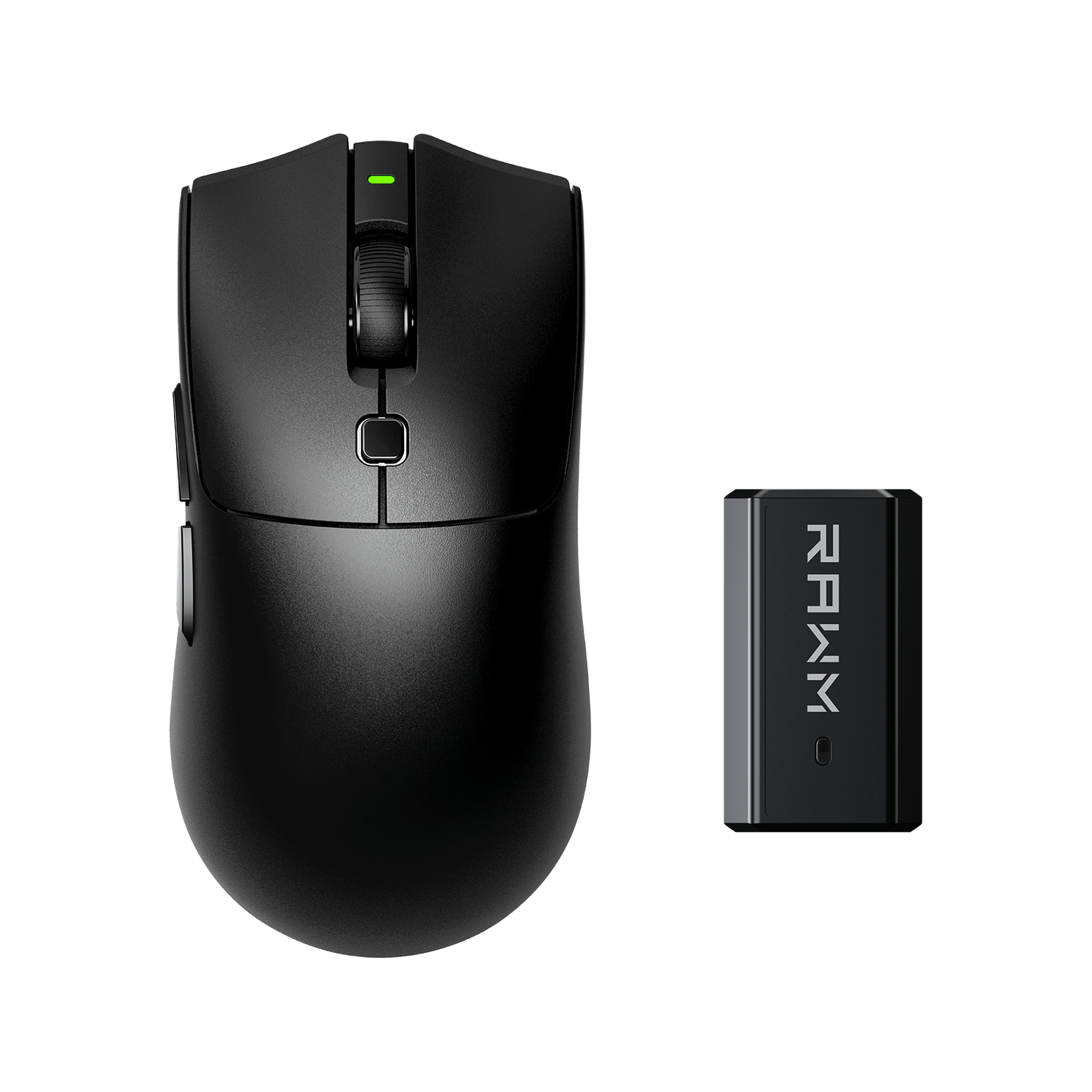
By contrast, optical gaming mice such as the RAWM ES21PRO, equipped with a PixArt 3950 optical sensor, deliver smoother, more predictable tracking that mirrors your physical movement one-to-one.
| Scenario | Laser Mouse Behavior | Optical Mouse Behavior |
|---|---|---|
| Slow movement | Over-tracks, jittering | Smooth and stable |
| Rapid flicks | Acceleration spikes | Consistent speed |
| Surface changes | Alters sensitivity | Minimal impact |
| Competitive aim | Feels imprecise | Predictable control |
This fundamental inconsistency is the main reason laser mice are no longer favored by esports professionals.
3. The Disadvantages of a Laser Mouse in Gaming — Acceleration and Tracking Errors
Another critical point when discussing what are the disadvantages of a laser mouse is built-in acceleration.
Laser sensors often exhibit hardware-level acceleration, meaning the faster you move your mouse, the more the cursor moves on screen — even if the distance traveled physically is the same.
While this might not bother casual users, it’s devastating for competitive players who rely on consistent tracking.
Acceleration breaks muscle memory — the key to mastering aim consistency. You could make identical movements and get different results depending on your speed, which leads to frustration and reduced performance.
Let’s visualize this problem:
| Speed of Movement | Laser Mouse Cursor Distance | Optical Mouse Cursor Distance |
|---|---|---|
| Slow swipe | 10 cm | 10 cm |
| Medium swipe | 13 cm | 10 cm |
| Fast swipe | 16 cm | 10 cm |
This inconsistency makes it nearly impossible to train your reflexes accurately — one of the defining disadvantages of a laser mouse for gaming applications.
4. What Are the Disadvantages of a Laser Mouse — Surface Dependency and Lift-Off Issues
One of the lesser-known disadvantages of a laser mouse involves surface dependency and lift-off distance.
Although laser sensors can technically track on most surfaces, they perform poorly on textured or uneven mousepads, creating inconsistent readings. The deeper light penetration picks up noise that affects movement tracking.
Another major issue is high lift-off distance (LOD) — the height at which the mouse stops tracking when lifted off the surface.
Laser mice tend to have higher LOD values, meaning the cursor keeps moving even when you slightly lift the mouse during repositioning — a common motion in FPS and MOBA gameplay.
| Specification | Laser Mouse | Optical Mouse (e.g., ES21PRO) |
|---|---|---|
| Lift-Off Distance | 2.5 – 3.5 mm | 1.0 – 1.5 mm |
| Surface Versatility | High, but inconsistent | Stable and precise |
| Cursor Stability | Low | Very high |
| Ideal for Gaming | ❌ No | ✅ Yes |
This extra movement during lift-off can completely throw off your aim — another major disadvantage of a laser mouse.
5. Why Modern Gamers Avoid the Disadvantages of a Laser Mouse — The Rise of Optical Alternatives
With all these issues, it’s no surprise that modern gaming mice have largely abandoned laser sensors in favor of advanced optical technologies.
Today’s flagship gaming models — including the RAWM ES21PRO — use next-generation optical sensors like the PixArt 3950, capable of delivering true-to-motion precision, no acceleration, and ultra-low latency.
Optical sensors have evolved to outperform lasers in every measurable category relevant to gaming:
| Feature | Laser Mouse | Optical Mouse (PixArt 3950) |
|---|---|---|
| Accuracy | Moderate | Excellent |
| Latency | Slight delay | Ultra-low |
| Acceleration | Present | None |
| Energy Efficiency | High | Optimized |
| Surface Reliability | Variable | Stable on all gaming pads |
The RAWM ES21PRO embodies these improvements with professional-grade build quality and performance, offering players everything a laser mouse can’t — smooth, reliable, and competition-ready tracking.
This evolution is exactly why discussions about what are the disadvantages of a laser mouse are essential for gamers considering their next upgrade.
What Are the Disadvantages of a Laser Mouse and Should You Avoid Them?
So, what are the disadvantages of a laser mouse?
To recap:
-
Laser sensors over-track surface details, causing jitter and inconsistency.
-
They often include built-in acceleration, which disrupts aim precision.
-
They suffer from high lift-off distance and surface dependency.
-
Overall, they’re less reliable for competitive gaming environments.
While laser mice might still be suitable for general productivity or casual use, gamers seeking consistency, precision, and comfort should consider modern optical mice instead.
The RAWM ES21PRO, equipped with the PixArt 3950 sensor and lightweight ergonomic shell, exemplifies what today’s best optical mice offer — stable performance, flawless accuracy, and zero unwanted acceleration.
If you’ve ever wondered what are the disadvantages of a laser mouse, now you know: it’s not about capability but control. And when it comes to gaming, control is everything.
Have you ever experienced tracking inconsistencies or jitter while gaming?
Would you choose a laser or optical mouse for your next setup?
Share your experience below — your feedback helps other players make smarter choices!
>>See also Why are gaming mice so expensive? >>>>>