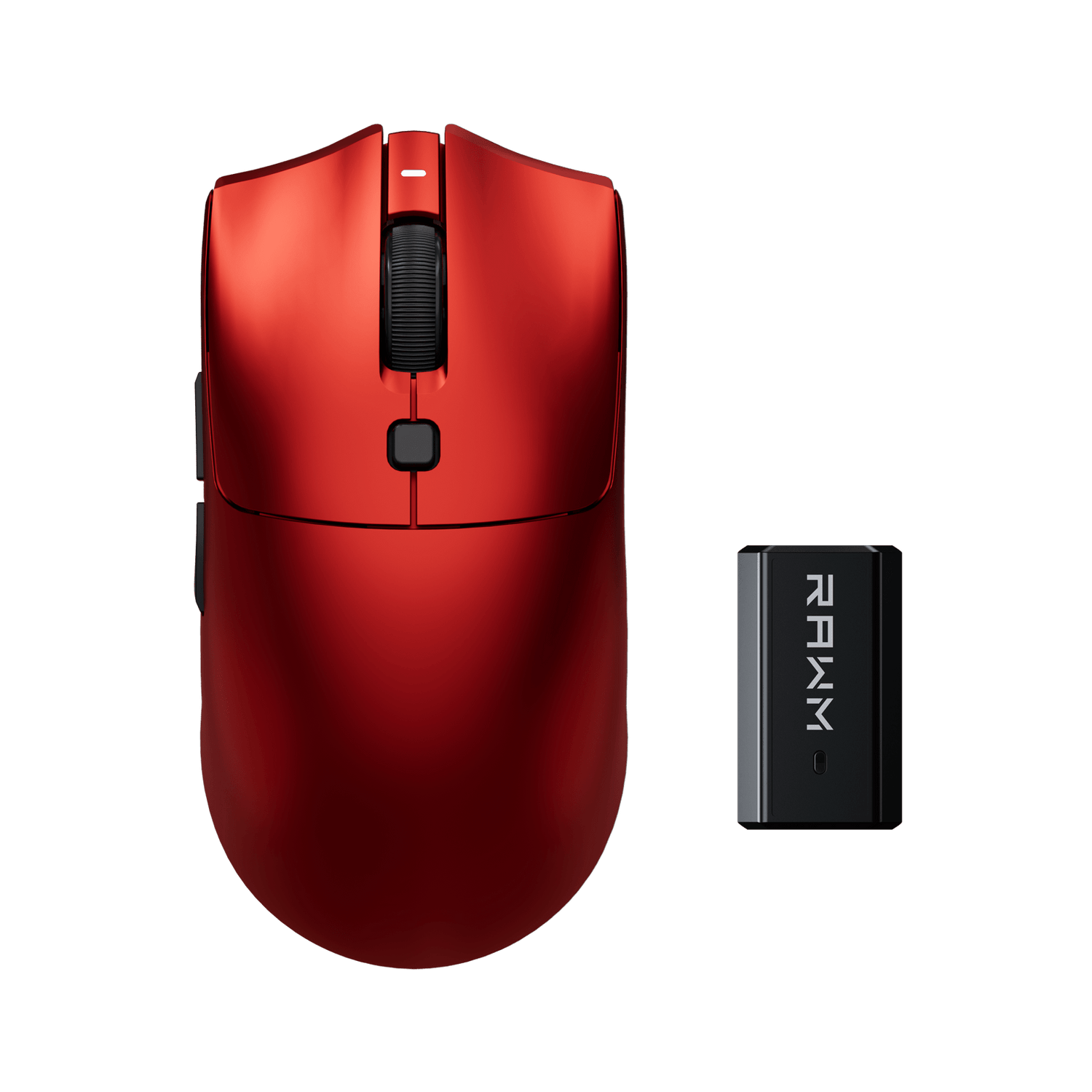
Gaming Mouse Grip Styles Guide (2026): Palm vs. Claw vs. Fingertip
When choosing a gaming mouse, most players immediately start comparing specifications such as sensor performance, DPI, polling rate, weight, and wireless technology.
But there's another factor that can have an equally important impact on your gaming experience: how you actually hold your mouse.
Your grip style affects how your hand interacts with the mouse, how much control you have over your movements, and how comfortable you feel during long gaming sessions.
The three most common gaming mouse grip styles are palm grip, claw grip, and fingertip grip.
Each one creates a different relationship between your hand and the mouse.
Palm grip provides the most support, with much of your hand resting against the mouse. Claw grip creates a balance between stability and agility by keeping the palm partially supported while the fingers remain arched. Fingertip grip minimizes contact between the hand and the mouse, giving you greater freedom to make quick adjustments.
But which grip style is actually best?
The answer isn't as simple as choosing the grip used by a professional gamer or copying the setup of a popular streamer.
Your ideal grip depends on several factors, including your hand size, the shape and dimensions of your mouse, your sensitivity settings, the games you play, and most importantly, what feels natural and comfortable to you.
A grip that works perfectly for one player may feel completely wrong for another.
For example, a large ergonomic mouse may feel incredibly comfortable for someone using a relaxed palm grip but feel restrictive to a fingertip player who prefers maximum freedom of movement.
Likewise, a lightweight symmetrical mouse that feels fast and responsive for a fingertip or claw grip player may not provide enough support for someone who prefers to rest their entire palm on the mouse.
Understanding your natural grip is therefore one of the most useful steps you can take before choosing a new gaming mouse.
This guide explains the three main gaming mouse grip styles, how each one works, and the advantages and disadvantages of palm, claw, and fingertip grip.
We'll also explore how grip style affects mouse shape, comfort, control, and gaming performance, helping you understand which type of mouse may be the best fit for your hand.
Whether you're buying your first gaming mouse, upgrading from an office mouse, or trying to improve your competitive FPS setup, understanding your grip style can help you make a much more informed decision.
By the end of this guide, you'll understand:
- What the three main gaming mouse grip styles are
- How palm, claw, and fingertip grip differ
- The advantages and disadvantages of each grip style
- Which gaming mouse shapes work best with different grips
- How hand size affects your grip and mouse choice
- Which grip styles may be better suited to FPS and other game genres
- How to identify your natural gaming mouse grip
- How to choose a gaming mouse that matches your grip style
Table of Contents
- What Are the Three Main Gaming Mouse Grip Styles?
- Palm Grip: Comfort and Stability
- Claw Grip: Balance Between Control and Agility
- Fingertip Grip: Maximum Freedom of Movement
- Palm vs. Claw vs. Fingertip: Which Grip Is Best?
- How Hand Size Affects Your Gaming Mouse Grip
- How Grip Style Influences Mouse Shape
- Can You Change Your Gaming Mouse Grip?
- How to Find Your Natural Grip Style
- How to Choose a Gaming Mouse Based on Your Grip Style
- Common Gaming Mouse Grip Mistakes to Avoid
- Frequently Asked Questions
Chapter 1: What Are the Three Main Gaming Mouse Grip Styles?
The way you hold your gaming mouse affects how your hand interacts with the mouse, how you control movement, and how comfortable you feel during long gaming sessions.
While every player has their own unique hand position, most gaming mouse grips fall into three broad categories: palm grip, claw grip, and fingertip grip.
These grip styles are mainly defined by how much of your hand touches the mouse.
With palm grip, most of your hand rests against the mouse, creating a stable and supported position. Claw grip uses partial palm contact combined with arched fingers, providing a balance between support and agility. Fingertip grip minimizes contact with the mouse, allowing your fingers to control movement with greater freedom.
None of these grip styles is universally "better" than the others.
The right choice depends on your hand size, mouse shape, sensitivity settings, the games you play, and most importantly, what feels natural and comfortable to you.
Palm Grip
Palm grip is generally the most relaxed of the three main gaming mouse grip styles.
With a palm grip, most of your palm rests against the rear and upper surface of the mouse. Your fingers usually lie relatively flat across the main buttons, while your thumb and other fingers rest naturally along the sides.
Because more of your hand is supported by the mouse, palm grip tends to feel stable and comfortable. The mouse and hand move together more naturally, with larger movements often coming from the arm and forearm rather than relying entirely on the wrist and fingers.
Palm grip is particularly popular among players who prioritize comfort and stability, especially during long gaming sessions.
Larger ergonomic mice are often a natural match for this grip, although symmetrical mice can also work well depending on their dimensions and the player's hand size.
Claw Grip
Claw grip sits between palm grip and fingertip grip.
Instead of allowing the entire palm to rest on the mouse, only the rear portion of the palm usually makes contact. The fingers are arched over the main buttons, creating the characteristic claw-like position.
This allows the player to maintain some palm support while keeping the fingers in a more active position.
The result is a balance between stability and agility. The rear of the mouse provides support, while the raised fingers can make quick clicks and small adjustments more easily.
Claw grip is particularly common among competitive gamers because it can provide a responsive feel without completely sacrificing comfort.
The exact position can vary from player to player. Some claw grip users keep more of their palm against the mouse, while others use a much more aggressive finger arch with minimal palm contact.
Fingertip Grip
Fingertip grip involves the least contact between your hand and the mouse.
Only the fingertips touch the mouse, while the palm remains completely or mostly lifted away from the shell.
This allows the player to control the mouse primarily through finger and wrist movements. Because the palm is not anchored to the mouse, the hand has greater freedom to make rapid directional changes.
Fingertip grip can feel particularly agile and responsive, making it appealing to players who prioritize quick adjustments and a lightweight, unrestricted feeling.
Smaller or lower-profile mice are often popular among fingertip grip users, although the ideal size still depends heavily on individual hand dimensions.
The main trade-off is support. With less of the hand resting on the mouse, some players may experience more finger or wrist fatigue during extended sessions.
Palm vs. Claw vs. Fingertip: What's the Difference?

The biggest difference between these three gaming mouse grip styles is the amount of contact between your hand and the mouse.
Palm Grip
Most of the palm rests on the mouse.
This provides the greatest amount of support and generally creates the most relaxed hand position. It is often favored by players who value comfort, stability, and long-session ergonomics.
Claw Grip
The rear of the palm makes partial contact while the fingers remain arched.
This creates a middle ground between stability and agility. Players can maintain some palm support while keeping their fingers ready for faster clicks and micro-adjustments.
Fingertip Grip
Only the fingertips touch the mouse.
This provides the greatest freedom of movement but also the least physical support. The player relies more heavily on finger and wrist control.
Think of the three grips as a spectrum:
Palm → More Support → Claw → More Agility → Fingertip
The closer you move toward a fingertip grip, the less your hand is anchored to the mouse. This can increase freedom of movement, but it may also require more active control.
The closer you move toward a palm grip, the more your hand is supported by the mouse. This can improve comfort and stability, but may feel less agile for some players.
Your Grip Style Can Change During Gameplay
It's also important to understand that most players don't maintain one perfectly fixed grip all the time.
Your hand position can naturally change depending on what you're doing.
For example, you might use a relaxed palm grip while browsing the web or playing a slower-paced game, then naturally shift toward a claw-like position during an intense FPS match.
You may also adjust your grip depending on your sensitivity settings.
A player using low sensitivity may rely more heavily on arm movements, while a high-sensitivity player may make more frequent adjustments using the wrist and fingers.
This is one reason why defining yourself as strictly a "palm grip player" or "claw grip player" isn't always necessary.
Your natural grip may sit somewhere between two categories, and that's completely normal.
Why Your Grip Style Matters When Choosing a Gaming Mouse
Your grip style is closely connected to the shape and size of your mouse.
A mouse that feels perfect for a palm grip player may feel too large or restrictive for someone who uses a fingertip grip.
Similarly, a low-profile mouse that feels fast and agile for a fingertip player may not provide enough support for someone who prefers a full palm grip.
When choosing a gaming mouse, consider how your grip interacts with:
- Mouse length
- Mouse width
- Mouse height
- Rear hump position
- Overall shell shape
- Weight
- Hand size
This is why grip style should be considered alongside mouse shape rather than treated as a completely separate factor.
If you're still unsure how your hand size and preferred grip should influence your mouse choice, understanding gaming mouse size and shape is the logical next step.
💡 Expert Tip
Don't force yourself into a grip style simply because it is popular among professional players.
Professional gamers often have very specific hand sizes, sensitivity settings, mouse shapes, and personal habits. Their preferred grip may work perfectly for them but feel uncomfortable for you.
Instead, start with the way your hand naturally rests on the mouse.
If your hand feels relaxed and supported, you're probably closer to a palm grip. If your fingers naturally arch while your palm maintains partial contact, you may be using a claw grip. If only your fingertips touch the mouse, you're likely closer to a fingertip grip.
Once you understand your natural position, you can choose a mouse shape that supports it rather than trying to completely change your grip to fit a particular mouse.
Key Takeaways
- Most gaming mouse grips fall into three main categories: palm, claw, and fingertip.
- Palm grip provides the most hand support and generally emphasizes comfort and stability.
- Claw grip balances partial palm support with more active finger control.
- Fingertip grip provides maximum freedom of movement but less physical support.
- Your grip can naturally change depending on the game, sensitivity, and situation.
- There is no universally best grip style for every gamer.
- Mouse shape and size should be considered together with your natural grip style.
- Your own comfort and control are more important than copying the grip of a professional player.
Chapter 2: Palm Grip – Comfort and Stability
Palm grip is often considered the most relaxed and supported of the three main gaming mouse grip styles.
With this grip, most of your palm rests against the rear and upper surface of the mouse, while your fingers lie relatively flat across the main buttons. Your thumb and pinky typically rest along the sides, creating a stable connection between your hand and the mouse.
Because a large portion of your hand remains in contact with the mouse, palm grip naturally provides a high level of support.
For many players, this makes it one of the most comfortable grip styles for long gaming sessions.
How Palm Grip Works
When using a palm grip, your hand and mouse tend to move together as a single unit.
Larger movements often come from the arm and forearm, while the wrist and fingers provide smaller adjustments. This can create a smooth and controlled feeling, particularly for players who use lower sensitivity settings.
The palm also helps stabilize the mouse during movement.
Instead of relying heavily on your fingertips to keep the mouse under control, your hand naturally rests on the shell and provides additional support.
This can be particularly useful when tracking targets over longer distances or making broad movements across a large mouse pad.
However, the same stability that makes palm grip comfortable can also reduce the feeling of agility for some players.
Because more of your hand is anchored to the mouse, making extremely fast micro-adjustments with your fingers may feel less natural compared with a claw or fingertip grip.
The Advantages of Palm Grip
One of the biggest advantages of palm grip is comfort.
With most of your hand supported by the mouse, there is generally less need to keep your fingers actively raised or tense throughout a gaming session.
This can make palm grip particularly appealing to players who spend several hours at their desk.
Other potential advantages include:
- Strong overall hand support
- Stable and consistent mouse control
- Comfortable position for extended sessions
- Natural arm-based aiming
- Smooth large movements
- Reduced reliance on fingertip control
Palm grip can also feel more natural for players who are transitioning from a traditional office mouse to a dedicated gaming mouse.
The Limitations of Palm Grip
Palm grip isn't perfect for everyone.
Because the hand is more firmly connected to the mouse, some players may find it harder to perform extremely fast micro-adjustments or rapid directional movements using only their fingers.
This doesn't mean palm grip is unsuitable for competitive gaming.
Many competitive players successfully use palm or palm-hybrid grips, particularly when playing at lower sensitivity and relying on larger arm movements.
The main consideration is whether the mouse shape allows your hand to remain comfortable while still giving you enough freedom to control the mouse precisely.
A mouse that is too large can feel restrictive, while a mouse that is too small may fail to provide enough palm support.
What Mouse Shape Is Best for Palm Grip?

Palm grip generally works well with mice that provide enough surface area for your palm to rest comfortably.
Many palm grip users prefer:
- Medium to large mice
- Higher rear humps
- Longer mouse bodies
- Ergonomic shapes
- Supportive rear sections
The position of the hump can be particularly important.
A mouse with a rear hump that supports the center of your palm may feel more comfortable than a low-profile mouse that leaves much of your hand unsupported.
However, mouse shape is highly personal.
Two mice with similar dimensions can feel completely different because of differences in their curves, hump position, side shape, or overall design.
This is why dimensions alone don't always tell the full story when choosing a mouse for palm grip.
Is Palm Grip Good for FPS Gaming?
Yes.
Palm grip can work extremely well for FPS games, particularly for players who use lower sensitivity settings and rely on arm movements for aiming.
In games such as Counter-Strike 2 and VALORANT, where precise tracking and controlled crosshair placement are important, a stable grip can provide a consistent aiming experience.
However, palm grip isn't automatically better for FPS gaming.
Competitive performance depends on many factors, including sensitivity, mouse shape, hand size, aiming technique, and personal preference.
Some FPS players may prefer the additional finger control of a claw grip, while others may feel more comfortable with the stability of a palm grip.
The best approach is to find the grip that allows you to aim consistently without creating unnecessary tension or discomfort.
Who Should Consider Palm Grip?
Palm grip may be a good option if you:
- Prefer a relaxed hand position
- Play for long periods
- Have medium to large hands
- Prefer larger or ergonomic mice
- Use lower mouse sensitivity
- Rely heavily on arm aiming
- Want more physical support from your mouse
It can also be a good starting point for players who are unsure which grip they naturally use.
If your entire hand naturally settles onto the mouse and your palm feels comfortable resting against the shell, you may already be using a palm grip without consciously thinking about it.
💡 Expert Tip
Don't assume that a larger mouse is automatically better for palm grip.
The goal is to support your hand without restricting its movement.
If your mouse is too large, your fingers may struggle to reach the buttons comfortably or your hand may feel locked into one position. If it's too small, your palm may hang off the rear of the mouse and create unnecessary tension.
The ideal palm grip mouse should support your hand while still allowing natural movement.
Key Takeaways
- Palm grip allows most of your hand to rest on the mouse.
- It generally provides strong support and a relaxed feeling.
- Palm grip can work well for long gaming sessions and lower-sensitivity aiming.
- Larger and ergonomic mice are often popular among palm grip users.
- Mouse size and hump position can significantly affect palm grip comfort.
- Palm grip can work well for competitive FPS games when it matches the player's aiming style.
- A mouse that is too large or too small can make palm grip uncomfortable.
- The best palm grip mouse should support your hand without restricting natural movement.
Chapter 3: Claw Grip – The Balance Between Control and Agility
Claw grip sits between palm grip and fingertip grip, combining some of the stability of a palm grip with the faster finger control of a fingertip grip.
With this grip, the rear portion of your palm usually makes partial contact with the mouse, while your fingers arch upward over the main buttons. This creates the characteristic "claw" shape that gives the grip its name.
For many gamers, this combination offers a useful balance.
Your palm provides enough support to keep the mouse stable, while your raised fingers remain active and ready to make quick clicks and precise adjustments.
This is one reason claw grip is particularly popular among competitive FPS players.
How Claw Grip Works
Unlike a relaxed palm grip, your fingers are more actively involved when using a claw grip.
The fingertips typically make contact with the main buttons, while the fingers remain naturally curved rather than lying completely flat.
The rear of the mouse supports part of your palm, helping anchor the hand during movement.
This creates a more dynamic connection between the player and the mouse.
Large movements can still come from the arm and forearm, but the arched fingers allow faster micro-adjustments through the fingertips and wrist.
The exact position can vary considerably between players.
Some users maintain relatively strong palm contact and use a relaxed claw position, while others keep only the rear of the palm against the mouse and use a more aggressive finger arch.
Both can still be considered variations of claw grip.
The Advantages of Claw Grip
The biggest advantage of claw grip is its balance.
It provides more support than fingertip grip while generally allowing more finger movement than palm grip.
This can make it a versatile choice for players who want both stability and responsiveness.
Other advantages include:
- Fast clicking
- Precise micro-adjustments
- Good balance between control and agility
- Strong fingertip control
- Quick directional changes
- Suitable for a wide range of competitive games
For FPS players, this combination can be particularly useful.
When tracking an opponent, your palm can help stabilize the mouse. When you need to make a quick flick or small correction, your fingers can contribute additional control.
The Limitations of Claw Grip
The main drawback of claw grip is that it can place more tension on your fingers than a relaxed palm grip.
Because your fingers remain naturally arched, they are more active throughout gameplay.
For some players, this is completely comfortable. For others, maintaining the position for several hours can eventually lead to finger or hand fatigue.
Mouse shape also plays a major role.
A mouse that is too flat may provide insufficient palm support, while a mouse with an overly aggressive hump may force your hand into an uncomfortable position.
The goal is to find a shape that supports the rear of your palm without preventing your fingers from maintaining a natural arch.
What Mouse Shape Is Best for Claw Grip?
Claw grip is generally more flexible than palm grip when it comes to mouse shape.
Many claw grip users prefer mice that provide:
- Medium-sized dimensions
- A supportive rear hump
- Moderate to high back height
- A shape that allows the fingers to arch naturally
- Enough length to support the rear of the palm
- A relatively narrow front section for precise finger control
The position of the hump can be particularly important.
A rear-positioned hump can provide more palm support while leaving the fingers free to arch over the buttons.
A more centrally positioned hump may provide a different type of support and can work better for players whose grip sits somewhere between palm and claw.
This is why two mice with nearly identical length and width can feel completely different when using a claw grip.
The shape of the rear shell, the height of the hump, and the angle of the sides can all influence how naturally your fingers sit on the mouse.
Is Claw Grip Good for FPS Gaming?
Claw grip is one of the most popular choices for competitive FPS gaming.
Games such as VALORANT, Counter-Strike 2, and other tactical shooters often require a combination of precise tracking, controlled crosshair placement, and fast flick shots.
Claw grip can provide a useful balance between these requirements.
The palm offers stability during controlled movements, while the fingers can make quick adjustments when a target suddenly changes direction.
This doesn't mean claw grip automatically makes someone better at FPS games.
Your sensitivity, aiming technique, mouse shape, and experience still matter far more than the grip label itself.
However, if you naturally use a claw grip, choosing a mouse that supports this position can make it easier to maintain consistent control.
Relaxed Claw vs. Aggressive Claw

Not every claw grip looks the same.
Some players use what is often described as a relaxed claw grip.
In this position, the fingers are only slightly arched and more of the palm remains in contact with the mouse. The overall position is closer to a combination of palm and claw grip.
Others use a more aggressive claw grip, where the fingers are noticeably curved and the palm has minimal contact with the mouse.
These two variations can feel very different.
A relaxed claw grip may benefit from a mouse with more overall palm support, while an aggressive claw grip may work better with a shape that gives the fingers more room to move.
This is another reason why simply knowing that you use a "claw grip" isn't always enough when choosing a mouse.
The specific way your fingers and palm interact with the shell matters just as much.
Who Should Consider Claw Grip?
Claw grip may be a good option if you:
- Play competitive FPS games
- Want a balance between stability and speed
- Prefer active fingertip control
- Make frequent micro-adjustments
- Use medium-sized gaming mice
- Want more agility than a traditional palm grip
- Still want some palm support
It can also be a natural middle ground for players who find palm grip too restrictive but fingertip grip too unsupported.
💡 Expert Tip
Don't force your fingers into an exaggerated claw position just because you think it will make you aim faster.
Your grip should feel natural.
If your fingers are constantly tense or your hand feels uncomfortable after a short gaming session, the problem may not be your grip style itself. Your mouse shape, size, or hump position may simply be a poor match for your hand.
A good claw grip should feel active and responsive without requiring constant tension.
Key Takeaways
- Claw grip combines partial palm support with arched fingers.
- It offers a balance between stability and fingertip control.
- Claw grip is particularly popular among competitive FPS players.
- A supportive rear hump can help maintain a comfortable claw position.
- Mouse shape and hump position can significantly affect claw grip comfort.
- Relaxed claw and aggressive claw are two common variations.
- Claw grip can provide excellent micro-adjustment and clicking control.
- The best claw grip should feel responsive without creating unnecessary finger tension.
Chapter 4: Fingertip Grip – Maximum Freedom of Movement
Fingertip grip is the least supported of the three main gaming mouse grip styles.
With this grip, only your fingertips make contact with the mouse. Your palm remains completely or mostly lifted away from the shell, allowing your fingers to control the mouse directly.
Instead of relying heavily on the palm to stabilize the mouse, fingertip grip gives your hand a much greater degree of freedom.
Small movements can be made quickly through the fingers and wrist, while larger movements can still involve the arm and forearm.
This can create an extremely agile and responsive feeling, particularly for players who enjoy lightweight mice and fast directional adjustments.
However, the increased freedom comes with a trade-off: less physical support.
Because your palm isn't resting on the mouse, your fingers remain more active throughout gameplay. For some players this feels natural and effortless, while others may experience more fatigue during longer sessions.
How Fingertip Grip Works
The defining feature of fingertip grip is simple: your fingertips are the only part of your hand directly controlling the mouse.
Your palm stays away from the shell, while your fingers make contact with the main buttons and sides of the mouse.
This gives you greater freedom to move the mouse independently from your palm.
Compared with palm grip, where the hand and mouse often move together, fingertip grip allows the mouse to be repositioned through small finger movements without requiring your entire hand to move with it.
This can be especially useful for making rapid micro-adjustments.
The grip also allows players to quickly change the direction of the mouse without feeling as physically anchored to the shell.
For some gamers, this creates a very fast and responsive experience.
The Advantages of Fingertip Grip
The biggest advantage of fingertip grip is freedom of movement.
With no palm contact restricting the hand, your fingers can make very small and precise adjustments while maintaining a high degree of control.
Other advantages include:
- Maximum freedom of movement
- Excellent fingertip control
- Fast directional adjustments
- Strong micro-adjustment potential
- Lightweight and agile feeling
- Minimal physical contact with the mouse
Fingertip grip can be particularly appealing to players who prefer to make frequent small corrections with their fingers rather than relying primarily on arm movement.
It can also feel very natural with lightweight gaming mice, where the reduced weight makes rapid repositioning easier.
The Limitations of Fingertip Grip
The main disadvantage of fingertip grip is the lack of support.
Because your palm does not rest on the mouse, your fingers and wrist remain more active throughout the gaming session.
This can potentially lead to fatigue, especially if your grip is too tense or your mouse shape doesn't match your hand.
Another consideration is stability.
Some players may find fingertip grip less stable than palm or claw grip when performing large, controlled movements.
This doesn't mean fingertip grip is inaccurate.
A skilled player can achieve excellent precision with fingertip control, but it may require more active hand control and a comfortable mouse that doesn't force the fingers into awkward positions.
What Mouse Shape Is Best for Fingertip Grip?
Fingertip grip often works well with smaller, lighter, and lower-profile mice, but there is no universal size that works for every player.
Many fingertip grip users prefer mice with:
- Lightweight construction
- Shorter overall length
- Lower or moderate height
- Less aggressive rear hump
- Narrower dimensions
- Easy-to-control side buttons
The goal is to give your fingers enough freedom to move the mouse without your palm being forced against the shell.
A mouse that is too long or too tall may unintentionally push against the palm, making it difficult to maintain a true fingertip position.
On the other hand, a mouse that is too small may cause your fingers to feel cramped or force you to grip the sides too tightly.
This is why hand size remains important even for fingertip grip users.
Is Fingertip Grip Good for FPS Gaming?
Fingertip grip can work very well for FPS gaming, especially for players who prioritize fast micro-adjustments and rapid directional changes.
In games such as VALORANT and Counter-Strike 2, small corrections can make a significant difference when tracking a moving target or adjusting crosshair placement.
The freedom provided by fingertip grip can make these movements feel quick and responsive.
However, fingertip grip isn't automatically better for competitive FPS games.
A player's sensitivity settings, aiming technique, mouse control, and consistency are still more important than the grip itself.
Some players may find that fingertip grip gives them excellent control at higher sensitivity, while others may prefer a claw or palm grip when using lower sensitivity and larger arm movements.
The key is finding a setup that allows you to make precise adjustments without creating unnecessary tension.
Fingertip Grip and Lightweight Gaming Mice

Fingertip grip is often associated with lightweight gaming mice.
This makes sense because a lighter mouse generally requires less physical effort to reposition.
When your palm isn't supporting the mouse, reducing its weight can make rapid movements feel easier and more natural.
However, lightweight doesn't automatically mean better.
A mouse can be extremely light but still feel uncomfortable if its shape doesn't match your hand.
For fingertip grip users, the relationship between weight and shape is often more important than weight alone.
A slightly heavier mouse with a comfortable shape may provide better control than an ultra-light mouse that forces your fingers into an awkward position.
Who Should Consider Fingertip Grip?
Fingertip grip may be a good option if you:
- Prefer maximum freedom of movement
- Enjoy lightweight gaming mice
- Make frequent micro-adjustments
- Prefer active finger and wrist control
- Use smaller or lower-profile mice
- Find palm contact restrictive
- Want an agile and responsive feeling
It may also be worth considering if you naturally lift your palm away from the mouse during gameplay.
If your hand already controls the mouse primarily through your fingertips, you may already be using a fingertip grip without realizing it.
💡 Expert Tip
Don't choose a fingertip grip simply because you think it will make your movements faster.
The best grip is the one that allows you to maintain precise control without unnecessary tension.
If your fingers are constantly squeezing the sides of the mouse or your wrist feels uncomfortable after extended use, your mouse may not be the right size or shape for your hand.
Fingertip grip should give you freedom—not force you to constantly fight the mouse.
Key Takeaways
- Fingertip grip uses the least amount of hand contact with the mouse.
- Only the fingertips typically touch the mouse while the palm remains lifted.
- The main advantage is maximum freedom of movement and fingertip control.
- Fingertip grip can be excellent for rapid micro-adjustments and directional changes.
- Lightweight mice can work particularly well with fingertip grip, but shape is still critical.
- A mouse that is too large or tall may interfere with natural fingertip movement.
- Fingertip grip provides less physical support than palm or claw grip.
- Comfort and hand size should still be considered when choosing a fingertip grip mouse.
Chapter 5: Palm vs. Claw vs. Fingertip – Which Grip Is Best?
After looking at palm, claw, and fingertip grip individually, the obvious question is: which gaming mouse grip style is actually the best?
The short answer is that there is no universal winner.
Each grip offers a different balance between support, comfort, agility, and control. The best option depends on your hand size, mouse shape, sensitivity, gaming preferences, and how naturally your hand rests on the mouse.
Instead of asking which grip is objectively better, it's more useful to ask which grip gives you the best combination of comfort and control.
Palm vs. Claw vs. Fingertip at a Glance

The three main grip styles can be compared across several important factors.
| Grip Style | Hand Support | Agility | Micro-Adjustments | Long-Session Comfort | Typical Mouse Preference |
|---|---|---|---|---|---|
| Palm | High | Moderate | Moderate | High | Larger, supportive shapes |
| Claw | Medium | High | High | Medium to High | Medium-sized, supportive rear |
| Fingertip | Low | Very High | Very High | Medium | Lightweight, smaller or lower-profile |
These are general tendencies rather than strict rules.
A player's personal experience can vary significantly depending on their hand size, mouse shape, sensitivity, and individual technique.
Which Grip Is Best for FPS Games?
All three grip styles can work for FPS gaming.
The more important question is how each grip interacts with your aiming technique.
Palm Grip for FPS
Palm grip can be a strong choice for players who use lower sensitivity and rely heavily on arm movements.
The additional hand support can help maintain a stable and consistent position while making larger movements across the mouse pad.
This can be particularly useful for players who prefer a controlled aiming style.
However, some players may find that the additional palm contact limits their ability to make very fast micro-adjustments.
Claw Grip for FPS
Claw grip is often considered a versatile option for competitive FPS players.
It provides some of the stability of palm grip while allowing the fingers to remain more active.
This can be useful when switching between large tracking movements and quick flicks or corrections.
For players who want a balance between control and responsiveness, claw grip can be a particularly natural fit.
Fingertip Grip for FPS
Fingertip grip emphasizes freedom of movement and rapid finger control.
It can be useful for players who prefer making frequent small adjustments and want minimal physical restriction from the mouse shell.
However, maintaining precise control over large movements may require more active hand and wrist coordination.
Ultimately, the best grip for FPS gaming is the one that allows you to aim consistently without creating unnecessary tension.
Which Grip Is Best for Long Gaming Sessions?
If comfort over several hours is your highest priority, palm grip often has an advantage because more of your hand is supported by the mouse.
However, this doesn't mean palm grip is automatically the most comfortable option for everyone.
Some players naturally find claw grip more comfortable because it allows them to maintain partial palm support while keeping their fingers more active.
Others may prefer fingertip grip because they dislike having their palm touch the mouse at all.
Your comfort depends heavily on your natural hand position and the mouse you are using.
A well-shaped mouse can make a huge difference.
A poor-fitting mouse can make even a theoretically comfortable grip feel tiring after a few hours.
Which Grip Gives the Most Control?
Control is difficult to measure because it depends on what kind of control you need.
Palm grip offers strong overall stability.
Claw grip provides a combination of stability and fingertip control.
Fingertip grip provides the greatest freedom for small adjustments.
If you prefer broad, controlled movements, palm grip may feel more natural.
If you want a balance between large movements and quick corrections, claw grip may be ideal.
If you prioritize maximum freedom for rapid micro-adjustments, fingertip grip may feel better.
In other words, more freedom doesn't automatically mean more control.
The best grip is the one that allows you to make the movements you need consistently and comfortably.
Grip Style and Mouse Sensitivity
Your sensitivity settings can also influence which grip feels most natural.
Players using lower sensitivity often make larger movements across the mouse pad. This can favor grips that provide strong stability and allow the arm to contribute significantly to aiming.
Players using higher sensitivity may rely more heavily on wrist and finger movements, where a more agile grip can feel comfortable.
However, there is no strict rule connecting sensitivity to grip style.
You can use low sensitivity with a claw grip or high sensitivity with a palm grip.
Your sensitivity should be chosen based on your aiming preferences and game requirements, not simply based on the grip you use.
Your Mouse Shape May Matter More Than Your Grip Label
It's easy to become overly focused on whether you're a palm, claw, or fingertip player.
But in reality, your mouse shape may have a greater impact on your experience than the name of your grip.
Two players may both use a claw grip but prefer completely different mice.
One may prefer a high rear hump that supports the palm, while another may prefer a flatter shape that gives the fingers more freedom.
This is why choosing a gaming mouse should involve looking at the entire relationship between:
- Your hand size
- Your natural grip
- Mouse length
- Mouse width
- Mouse height
- Hump position
- Side shape
- Mouse weight
A good match between these factors can make a mouse feel natural almost immediately.
A poor match can make you constantly adjust your hand position, even if the mouse itself has excellent specifications.
Can You Have a Hybrid Grip?
Absolutely.
Not every player fits neatly into one of the three categories.
You may naturally use a grip that combines elements of two styles.
For example, a player might rest part of their palm on the mouse while keeping their fingers significantly arched. This could be described as a relaxed claw or palm-claw hybrid.
Another player might keep the rear of their palm barely touching the mouse while controlling most movement through their fingertips.
These hybrid positions are completely normal.
The three grip styles are best understood as broad categories rather than strict rules.
Your grip can exist somewhere between them, and it can change depending on the game, sensitivity, mouse shape, or even your level of fatigue.
💡 Expert Tip
Don't try to "correct" your grip just because you don't perfectly match one of the three traditional categories.
The purpose of understanding palm, claw, and fingertip grip is to help you understand your preferences—not to force your hand into a specific position.
If your current grip feels comfortable, allows consistent control, and doesn't create unnecessary tension, there's no reason to change it simply to fit a particular label.
Key Takeaways
- There is no universally best gaming mouse grip style.
- Palm grip emphasizes support and stability.
- Claw grip offers a balance between stability and agility.
- Fingertip grip provides maximum freedom of movement.
- All three grips can work well for competitive FPS gaming.
- Mouse sensitivity can influence how a grip feels, but there are no strict sensitivity rules for each grip.
- Mouse shape and size can be just as important as grip style.
- Hybrid grips are common and completely normal.
- Comfort, consistency, and control matter more than fitting perfectly into one grip category.
Chapter 6: How Hand Size Affects Your Gaming Mouse Grip
Your grip style doesn't exist in isolation.
The way you hold a gaming mouse is closely connected to the size and proportions of your hand. A grip that feels natural on one mouse may feel completely different on another, even if both mice are designed for the same grip style.
This is why two players who both use a claw grip, for example, may have completely different preferences when it comes to mouse size and shape.
Hand size influences how much of your palm touches the mouse, where your fingers naturally sit on the main buttons, and how easily you can reach the side buttons.
Understanding this relationship can help you avoid one of the most common mistakes when buying a gaming mouse: choosing a mouse based only on specifications without considering how it actually fits your hand.
How to Measure Your Hand for a Gaming Mouse
Before comparing mouse dimensions, it's useful to know the approximate size of your hand.
You generally need two measurements:
Hand length: Measure from the tip of your middle finger to the crease at the base of your palm.
Hand width: Measure across the widest part of your hand, usually from the thumb side to the opposite edge of your palm.
These measurements don't determine your perfect mouse size by themselves, but they provide a useful starting point when comparing different models.
For example, a mouse that feels comfortably sized for a player with larger hands may feel oversized and restrictive for someone with smaller hands.
Likewise, a compact mouse that feels agile for smaller hands may force a larger-handed player into an uncomfortable or overly cramped grip.
Larger Hands and Gaming Mouse Grip
Players with larger hands often have more flexibility when choosing between palm, claw, and fingertip grip, but mouse dimensions become especially important.
A mouse that is too short may leave part of the palm unsupported, causing the hand to extend beyond the rear of the shell.
A mouse that is too narrow may also cause the fingers to curl excessively around the sides.
For larger hands, a longer or wider mouse may provide a more natural fit.
Palm grip users with larger hands often benefit from mice with sufficient length and a supportive rear section.
Claw grip users may prefer a medium-to-large mouse with enough rear support to accommodate the palm while leaving space for the fingers to arch naturally.
Fingertip grip users may still prefer smaller mice, but the mouse must provide enough room for the fingers to rest comfortably without excessive squeezing.
Smaller Hands and Gaming Mouse Grip
Players with smaller hands may find that large mice are more difficult to control comfortably.
A long mouse can make it harder to reach the main buttons naturally, while a high rear hump may push against the palm and restrict movement.
Smaller hands often work well with shorter or more compact mouse designs, particularly for claw and fingertip grips.
However, this doesn't mean that players with smaller hands must always use small mice.
Some may prefer a larger mouse because they enjoy more palm support.
The key is whether the mouse allows your hand to maintain a natural position without forcing your fingers or wrist into an uncomfortable angle.
Hand Size and Palm Grip
Hand size can have a particularly noticeable effect on palm grip.
Because the palm rests directly against the mouse, the mouse needs to provide enough surface area to support the hand comfortably.
If the mouse is too short, your palm may extend beyond the rear of the shell.
If it is too tall or wide, the mouse may feel bulky and restrict movement.
For palm grip users, the position of the rear hump is often just as important as the overall length.
A hump positioned toward the rear can provide strong support for the palm, while a more centrally positioned hump may distribute support differently.
This is why two mice with similar dimensions can still feel completely different in a palm grip.
Hand Size and Claw Grip
Claw grip can be more forgiving when it comes to mouse size because the palm doesn't need to rest fully on the shell.
However, the mouse still needs to provide enough support for the rear of the palm while giving the fingers enough space to maintain a natural arch.
A mouse that is too small may cause the fingers to curl too aggressively.
A mouse that is too large may force the palm into too much contact and make the grip feel closer to a palm grip.
For many claw grip users, the ideal mouse sits somewhere in the middle: long enough to support the rear of the hand but compact enough to allow active finger control.
Hand Size and Fingertip Grip
Fingertip grip is often less dependent on overall mouse length because the palm doesn't rest on the mouse.
However, hand width and finger length still matter.
If the mouse is too narrow, you may need to squeeze the sides to maintain control.
If it is too wide, your fingers may have difficulty reaching the sides comfortably.
The ideal fingertip grip mouse should allow your fingers to rest naturally on the main buttons and sides without requiring constant tension.
This is one reason why some fingertip players prefer compact, lightweight mice.
However, the best size is still determined by the player's individual hand dimensions.
Is Hand Size More Important Than Grip Style?

Neither factor should be considered in isolation.
Your hand size determines what mouse dimensions are physically comfortable, while your grip style determines how your hand interacts with those dimensions.
Think of the relationship like this:
Hand Size → Determines the range of suitable mouse dimensions
Grip Style → Determines how you use those dimensions
Mouse Shape → Determines how the mouse actually feels in your hand
A mouse can have the correct length for your hand but still feel uncomfortable because the hump is in the wrong position.
Similarly, a mouse can be designed for your preferred grip style but still feel too wide or too narrow.
The best fit comes from considering all three factors together.
Why Mouse Dimensions Aren't Everything
Mouse specifications often list length, width, and height in millimeters.
These numbers are useful, but they don't tell the entire story.
Two mice with nearly identical dimensions can feel completely different because of differences in:
- Rear hump position
- Hump height
- Side curvature
- Button shape
- Front width
- Side button placement
- Overall shell geometry
This is especially important when comparing mice designed for the same grip style.
A claw grip mouse with a rear hump may feel completely different from another claw grip mouse with a central hump, even if both have similar dimensions.
This is why product dimensions should be treated as a reference point rather than a guarantee of comfort.
💡 Expert Tip
If you're unsure whether a mouse is the right size, don't focus only on its listed dimensions.
Look at how the mouse's shape interacts with your hand.
Pay particular attention to where your palm contacts the rear hump, where your fingertips land on the main buttons, and whether your thumb and pinky can rest comfortably on the sides.
A few millimeters in length or width can matter, but the overall shape often matters just as much.
Key Takeaways
- Hand size plays an important role in determining gaming mouse comfort.
- Hand length and width are useful starting points when comparing mice.
- Larger hands may need more length or width, but this depends on grip style.
- Smaller hands may benefit from more compact mice, but larger shapes can still work for some players.
- Palm grip generally requires more overall mouse support.
- Claw grip often benefits from a balance between palm support and finger freedom.
- Fingertip grip provides more flexibility in mouse length but still depends heavily on width and finger placement.
- Mouse dimensions alone don't determine comfort.
- Hump position, side shape, and overall shell design can be just as important as length, width, and height.
Chapter 7: How Grip Style Influences Gaming Mouse Shape
Your grip style and your gaming mouse shape are closely connected.
You can have the perfect hand size for a particular mouse, but if the shell shape doesn't match the way you naturally hold it, the mouse may still feel uncomfortable or difficult to control.
This is why choosing a gaming mouse isn't simply about finding the right length and width.
The shape of the mouse determines where your palm rests, how your fingers reach the buttons, how your thumb sits on the side, and how freely you can move your hand.
A good mouse shape should work with your natural grip rather than forcing you to constantly adjust your hand.
Palm Grip and Mouse Shape
Palm grip generally benefits from a mouse that provides enough surface area to support the majority of the hand.
Many palm grip users prefer mice with:
-
Longer bodies
-
Higher rear sections
-
Larger overall dimensions
-
Rounded or ergonomic profiles
-
Supportive palm areas
The rear hump is particularly important.
A mouse with a higher rear hump can provide more support for the center of your palm, allowing your hand to rest naturally during extended sessions.
However, the position of the hump matters just as much as its height.
A hump positioned toward the rear of the mouse can provide strong palm support, while a more centrally positioned hump may distribute support differently across the hand.
For palm grip users, the goal is generally to find a shape that supports the palm without forcing the wrist or fingers into an unnatural position.
Claw Grip and Mouse Shape
Claw grip is highly sensitive to mouse shape because the fingers need enough room to remain naturally arched while the rear of the palm receives partial support.
Many claw grip players prefer mice with:
-
A supportive rear hump
-
Medium overall dimensions
-
Moderate to high back height
-
A narrower front section
-
Enough length for partial palm contact
The shape should allow the fingers to remain curved without feeling cramped.
If the mouse is too flat, the palm may not receive enough support.
If the rear hump is too tall or positioned incorrectly, the mouse may force the hand into an overly aggressive claw position.
This is why claw grip users often pay close attention to the exact shape of the rear shell.
A few millimeters of difference in hump position can significantly change how a mouse feels.
Fingertip Grip and Mouse Shape
Fingertip grip generally requires the least amount of palm support.
Because the palm remains lifted away from the mouse, fingertip players often prefer shapes that allow the fingers to control the mouse freely.
Common preferences include:
-
Shorter mouse bodies
-
Lower or moderate profiles
-
Lightweight construction
-
Less aggressive rear humps
-
Compact dimensions
A mouse that is too long may push against the palm and make it difficult to maintain a true fingertip position.
Likewise, a mouse with a very tall rear hump may feel restrictive because the hand cannot remain comfortably elevated.
However, fingertip grip doesn't necessarily mean you need the smallest mouse available.
The mouse still needs to provide enough surface area for your fingers to rest naturally.
If the mouse is too narrow or too small, you may find yourself squeezing the sides to maintain control.
The Importance of the Rear Hump

The rear hump is one of the most important features to consider when matching a mouse to your grip style.
The hump affects where your palm makes contact with the mouse and how your hand naturally settles onto the shell.
For example:
Palm grip: Usually benefits from stronger palm support.
Claw grip: Often benefits from a hump that supports the rear of the palm while leaving the fingers free to arch.
Fingertip grip: Usually benefits from a lower or less intrusive rear section.
However, these are general guidelines rather than strict rules.
A player with a relaxed claw grip may prefer a shape that is closer to a palm-oriented mouse, while an aggressive claw grip user may prefer a lower-profile shell.
The important thing is understanding how the hump interacts with your individual hand position.
Symmetrical vs. Ergonomic Shapes
Mouse shape can also be divided into two broad categories: symmetrical and ergonomic.
A symmetrical mouse generally has a more balanced shape that can work well for a wide range of grip styles.
Symmetrical designs are particularly popular among competitive FPS players because they often provide a consistent shape that allows flexible hand positioning.
They can work especially well for claw and fingertip grips, although many palm grip users also find symmetrical mice comfortable.
An ergonomic mouse is designed with a more pronounced shape intended to follow the natural contours of the hand.
These mice often provide stronger palm and thumb support.
This can make them particularly attractive to palm grip users, although some claw grip players also prefer ergonomic designs.
Neither shape is objectively better.
The right choice depends on how your hand naturally interacts with the shell.
Mouse Shape vs. Mouse Size
It's easy to confuse mouse shape with mouse size, but they are not the same thing.
Two mice can have almost identical dimensions but completely different shapes.
For example, one may have a high rear hump while the other has a flatter profile.
One may have sharply curved sides, while another has a wider and more gradual shape.
These differences can completely change how the mouse feels in your hand.
This is why simply checking the length, width, and height of a mouse isn't always enough.
When possible, consider:
-
Where the hump is located
-
How high the hump rises
-
How wide the rear of the shell is
-
How sharply the sides curve
-
Where the thumb naturally rests
-
Whether your pinky has enough support
-
How easily your fingers reach the main buttons
These details can be especially important when switching between different grip styles.
Grip Style Should Guide Your Mouse Choice
Your grip style shouldn't necessarily determine your mouse choice by itself.
Instead, it should help you narrow down the types of shapes that are most likely to feel comfortable.
A useful way to think about the process is:
Start with your hand size → Identify your natural grip → Choose a suitable shape → Compare dimensions → Test comfort and control
This approach is generally more reliable than simply buying a mouse because it is marketed as a "palm grip mouse" or "claw grip mouse."
Manufacturers may describe a mouse as suitable for a particular grip, but every player's hand is different.
A mouse designed for claw grip may work perfectly for one person and feel uncomfortable for another.
💡 Expert Tip
When comparing gaming mice, pay attention to where your hand makes contact with the shell, not just the official grip category.
If your palm feels supported, your fingers can rest naturally, and your thumb and pinky aren't constantly squeezing the sides, you're probably close to a good fit.
The goal isn't to find a mouse that matches a marketing label.
The goal is to find a shape that allows your natural grip to work comfortably.
Key Takeaways
-
Mouse shape is just as important as mouse size when choosing a gaming mouse.
-
Palm grip generally benefits from stronger palm support.
-
Claw grip often works well with supportive rear humps and enough room for arched fingers.
-
Fingertip grip usually benefits from less intrusive rear sections and greater freedom of movement.
-
Rear hump position can significantly affect how a mouse feels.
-
Symmetrical and ergonomic mice can both work well depending on your grip and hand shape.
-
Two mice with similar dimensions can feel completely different because of their shell geometry.
-
Your grip style should help guide your mouse shape selection, but it shouldn't be treated as a strict rule.
Chapter 8: Can You Change Your Gaming Mouse Grip Style?
Yes, you can change your gaming mouse grip style—but that doesn't necessarily mean you should.
Many players naturally develop a grip based on their hand size, the mouse they use, and the way they learned to play. Over time, this position can become automatic.
However, your grip isn't permanently fixed.
You may naturally change your hand position when switching between different mice, playing different games, or adjusting your sensitivity settings.
Some players also intentionally experiment with different grips to find a more comfortable or controlled position.
Why Would You Change Your Grip?
There are several reasons why a gamer might want to experiment with a different grip.
You may find that your current grip causes discomfort during long sessions.
Your mouse may also be poorly matched to your hand, forcing you into an awkward position.
For example, a player who uses a large mouse with a fingertip grip may find that the rear of the shell constantly touches their palm, making it difficult to maintain a natural position.
Likewise, someone using a very small mouse with a palm grip may find that their hand extends too far beyond the rear of the shell.
In these situations, changing the mouse may be a better solution than trying to completely retrain your grip.
However, some players may still want to experiment with a different grip because they prefer the feeling of increased stability or greater freedom of movement.
Can You Switch From Palm to Claw Grip?
Yes.
Palm and claw grip are relatively close to each other on the spectrum of hand contact.
A player using palm grip can gradually reduce palm contact while allowing the fingers to become more arched.
This creates a position that moves toward a relaxed claw grip.
For some players, this transition can feel relatively natural.
However, it may take time for your hand to become comfortable with the new position.
If your fingers feel tense or your wrist becomes uncomfortable, you may be trying to force the grip rather than allowing it to develop naturally.
The mouse shape also matters.
A mouse with a supportive rear hump may make the transition from palm to claw easier, while a very flat mouse may provide insufficient support.
Can You Switch From Claw to Fingertip Grip?
Claw and fingertip grip are also relatively close because both rely more heavily on active finger control.
To move from claw toward fingertip, you gradually reduce contact between your palm and the rear of the mouse.
Your fingers remain in control while your hand becomes less anchored to the shell.
This can increase freedom of movement, but it may also require more active control.
Players who naturally prefer lightweight mice may find the transition easier because a lighter mouse requires less effort to reposition.
However, the change should feel natural rather than forced.
Should You Change Your Grip to Improve Aim?
Changing your grip is not a guaranteed way to improve aim.
A new grip may feel more responsive, but that doesn't necessarily translate into better performance.
Aim consistency comes from many factors, including:
-
Mouse control
-
Sensitivity settings
-
Muscle memory
-
Hand comfort
-
Practice
-
Game-specific mechanics
If your current grip is comfortable and you can aim consistently, there may be little reason to change it.
On the other hand, if your grip causes discomfort or makes it difficult to control the mouse naturally, experimenting with another position may be worthwhile.
The goal should be to improve comfort and consistency—not simply to copy a grip used by another player.
How Long Does It Take to Adapt to a New Grip?
There is no universal timeline.
Some players may adjust within a few gaming sessions, while others may need significantly longer.
The process depends on how different the new grip is from your natural position and how much you practice with it.
A small adjustment, such as moving from palm to relaxed claw, may feel relatively easy.
A major change, such as moving from palm to fingertip, can require much more adaptation because your hand is using different muscles and movement patterns.
If you decide to experiment, it's generally better to make gradual changes rather than completely forcing your hand into a new position overnight.
Don't Confuse Grip Problems With Mouse Problems
Sometimes the problem isn't your grip.
It may simply be your mouse.
If your hand constantly feels cramped, your fingers struggle to reach the buttons, or your palm doesn't have enough support, changing your grip may only temporarily hide the real issue.
Before changing your natural grip, consider whether your mouse is:
-
Too long
-
Too short
-
Too wide
-
Too narrow
-
Too tall
-
Too flat
-
Too heavy
The right mouse can sometimes make your natural grip feel immediately more comfortable without requiring any conscious adjustment.
💡 Expert Tip
If you want to experiment with a new grip, don't change everything at once.
Try adjusting one element at a time.
For example, if you normally use palm grip, start by slightly lifting your palm and allowing your fingers to arch naturally. Play for a short period and see how the position feels.
If the new grip creates tension, discomfort, or reduced control, there's no need to force it.
Your natural grip is usually a better starting point than a grip chosen purely because it is popular.
Key Takeaways
-
You can change your gaming mouse grip style, but you don't necessarily need to.
-
Palm-to-claw transitions may feel relatively natural because the two grips share more palm contact.
-
Claw-to-fingertip transitions generally require greater adjustment.
-
Changing your grip isn't a guaranteed way to improve aim.
-
Comfort and consistency should be more important than copying another player's grip.
-
A poor mouse shape can sometimes be mistaken for a grip problem.
-
Gradual experimentation is usually easier than forcing a completely different grip.
-
If your current grip is comfortable and consistent, there may be no reason to change it.
Chapter 9: How to Find Your Natural Gaming Mouse Grip
If you're still unsure whether you use a palm, claw, or fingertip grip, the good news is that you don't need to overthink it.
Your natural grip is usually the position your hand automatically settles into when you're focused on the game.
Instead of deliberately forcing your hand into one of the three categories, start by paying attention to how you already hold your mouse.
Your natural grip can tell you a lot about the type of mouse shape that may feel most comfortable.
Start by Relaxing Your Hand
The easiest way to identify your grip is to stop thinking about your grip altogether.
Place your hand on your mouse as you normally would and relax.
Don't intentionally flatten your palm.
Don't deliberately arch your fingers.
Don't try to imitate a professional player.
Simply use the mouse naturally for a few minutes while browsing, playing a game, or moving the cursor around.
Then look at how your hand is positioned.
If most of your palm naturally rests against the mouse, you're probably closer to a palm grip.
If the rear portion of your palm touches the mouse while your fingers naturally arch over the buttons, you're likely using a claw grip.
If your palm stays mostly away from the shell and only your fingertips touch the mouse, you're likely closer to a fingertip grip.
Look at Your Palm Contact
One of the easiest ways to distinguish between grip styles is to focus on how much of your palm touches the mouse.
Mostly Full Palm Contact
If most of your palm is resting against the rear and upper portion of the mouse, you're likely using a palm grip.
This position generally creates the most physical support.
Partial Palm Contact
If only the rear part of your palm touches the mouse while the rest of your hand remains elevated, you're probably using some form of claw grip.
Your fingers will usually be noticeably arched.
Little or No Palm Contact
If your palm remains lifted away from the mouse and your fingers are doing most of the work, you're likely using a fingertip grip.
This provides the greatest freedom of movement but the least physical support.
Look at Your Fingers
Your finger position can also help identify your grip.
With palm grip, your fingers generally lie relatively flat across the main buttons.
With claw grip, your fingers are noticeably curved, with the fingertips contacting the buttons.
With fingertip grip, your fingers remain in contact with the mouse while the rest of your hand stays away from the shell.
Pay attention to how your fingers naturally rest when you're not consciously thinking about them.
If you have to deliberately maintain a particular finger position, it may not actually be your natural grip.
Pay Attention to How You Move the Mouse
Your grip isn't just about where your hand touches the mouse.
It's also about how you control movement.
If you tend to make large movements with your arm and forearm while keeping your hand relatively stable on the mouse, you may naturally prefer a palm-oriented grip.
If you combine arm movements with active wrist and finger adjustments, you may be closer to a claw grip.
If you make many small movements primarily through your fingers and wrist while keeping your palm lifted, you may be closer to a fingertip grip.
Again, these are tendencies rather than strict rules.
Your movement style can change depending on your sensitivity and the game you're playing.
Try Different Games
Your grip may also change depending on what you're doing.
Try observing your hand while playing different types of games.
For example, you may notice that:
-
You use a relaxed palm position during slower games.
-
You naturally move toward a claw grip during competitive FPS matches.
-
You use more fingertip control when making fast adjustments.
-
Your grip becomes more relaxed during casual gameplay.
This is completely normal.
Your grip isn't necessarily a permanent position that remains identical in every situation.
Use a Simple Three-Step Test

If you're still unsure, try this quick test.
Step 1: Place your hand on the mouse naturally.
Don't adjust your fingers or palm.
Step 2: Look at your palm contact.
Ask yourself whether most of your palm, only part of your palm, or almost none of your palm is touching the mouse.
Step 3: Look at your fingers.
Are they relatively flat, naturally arched, or only lightly touching the mouse?
You can then use the following general guide:
| What You Notice | Likely Grip |
|---|---|
| Most of your palm rests on the mouse and fingers are relatively flat | Palm Grip |
| Rear of palm touches the mouse and fingers are arched | Claw Grip |
| Palm is lifted and only fingertips control the mouse | Fingertip Grip |
If your hand doesn't perfectly match one category, that's completely fine.
You may naturally use a hybrid grip.
Your Grip May Change With Your Mouse
One important thing to remember is that your grip isn't always independent of your mouse.
Switching to a different shape can naturally change your hand position.
For example, a large ergonomic mouse may encourage you to rest more of your palm on the shell.
A smaller, lower-profile mouse may naturally encourage a more claw-like or fingertip-oriented position.
This means that you shouldn't necessarily assume your current grip will remain exactly the same with every mouse.
Your grip and your mouse shape influence each other.
This is also why trying a new mouse can sometimes feel strange for the first few hours.
Your hand may need time to adjust to a different hump position, width, or overall shape.
💡 Expert Tip
The best way to identify your natural grip is to observe your hand when you're not thinking about your grip.
If you consciously force your hand into a palm, claw, or fingertip position, you're measuring an artificial grip rather than your natural one.
Your natural grip is usually the position that feels comfortable when you're focused on the game rather than on your hand.
Key Takeaways
-
Your natural grip is usually the position your hand automatically adopts.
-
Palm contact is one of the easiest ways to distinguish between grip styles.
-
Finger position can help identify whether you're closer to palm, claw, or fingertip grip.
-
Your movement style can provide additional clues about your natural grip.
-
Your grip may change slightly between different games and situations.
-
Hybrid grips are common and don't need to fit perfectly into one category.
-
Changing your mouse shape can naturally change how you hold the mouse.
-
The best way to identify your grip is to observe your hand without consciously forcing a specific position.
Chapter 10: How to Choose a Gaming Mouse Based on Your Grip Style
Once you understand your natural grip, the next step is choosing a mouse that works with it.
Your grip style can help narrow down the types of mice you're likely to find comfortable, but it shouldn't be the only factor you consider.
Hand size, mouse dimensions, shape, weight, and even your preferred sensitivity all play a role in determining whether a mouse feels natural in your hand.
The goal isn't to find a mouse that is officially labeled for your grip.
The goal is to find a mouse that allows your natural grip to remain comfortable and consistent.
Start With Your Natural Grip
Before buying a new gaming mouse, identify how you naturally hold your current mouse.
Ask yourself:
-
Does most of my palm rest on the shell?
-
Do my fingers naturally arch over the buttons?
-
Does my palm stay mostly lifted?
-
Do I rely heavily on my fingertips for small adjustments?
-
Does my hand feel relaxed after several hours?
These questions can help you determine whether you're closer to palm, claw, or fingertip grip.
Once you know your natural position, you can start looking for mouse shapes that support it.
Choose the Right Mouse Size
Mouse size is one of the first things you should consider.
A mouse that is too large may restrict your fingers or force your hand into an awkward position.
A mouse that is too small may leave your palm unsupported or cause you to grip the sides too tightly.
As a general starting point:
Palm grip: Often works well with medium-to-large mice that provide enough surface area for palm support.
Claw grip: Often works well with medium-sized mice that provide rear palm support while allowing the fingers to remain naturally arched.
Fingertip grip: Often works well with smaller or lower-profile mice that allow the fingers to move freely without forcing the palm onto the shell.
These are starting points rather than strict rules.
Your hand proportions and personal preferences still matter more than a general size recommendation.
Consider the Mouse Shape
Once you have narrowed down the size, pay attention to the overall shape.
Look at:
-
Rear hump position
-
Hump height
-
Front width
-
Side curvature
-
Thumb rest
-
Pinky support
-
Overall shell profile
For palm grip, a supportive rear section can help your hand rest comfortably.
For claw grip, a well-positioned hump can provide palm support while leaving enough room for the fingers to arch.
For fingertip grip, a lower or less intrusive rear section can give your fingers more freedom.
The shape should complement the way your hand naturally moves.
Consider Weight
Mouse weight can also affect how your grip feels during gameplay.
A lighter mouse may feel easier to reposition, particularly for players who use fingertip or claw grip and make frequent small movements.
A heavier mouse may feel more stable to some players, particularly when making controlled arm movements.
However, weight is highly subjective.
A lightweight mouse isn't automatically better, and a heavier mouse isn't automatically more stable in every situation.
The ideal weight depends on your preferred aiming style, sensitivity, and how much physical effort you want to use when moving the mouse.
The most important thing is that the weight doesn't interfere with your ability to control the mouse comfortably.
Think About Your Gaming Style
Your preferred games can also influence your mouse choice.
Competitive FPS players may prioritize:
-
Low latency
-
Accurate tracking
-
Lightweight construction
-
Comfortable long-session control
MOBA and strategy players may place greater emphasis on button placement and overall comfort.
Players who spend time gaming and working on the same computer may prioritize ergonomics and long-term comfort over extreme weight reduction.
Your grip style is therefore only one part of the overall decision.
A mouse should fit both your hand and the way you use it.
Don't Ignore Your Sensitivity
Mouse sensitivity can influence how a particular grip feels.
Lower sensitivity generally requires larger movements, which can make a stable and comfortable grip particularly important.
Higher sensitivity involves more frequent small adjustments, where active finger and wrist control may feel more natural.
However, there is no universal rule that says palm grip must use low sensitivity or fingertip grip must use high sensitivity.
You can successfully use almost any sensitivity with any grip style.
The important thing is whether your grip allows you to control the mouse consistently at your chosen sensitivity.
Consider Wired vs. Wireless
Modern wireless gaming mice have largely eliminated the major performance concerns that once made wired mice the default choice for competitive players.
For most gamers, a high-quality wireless mouse can now provide excellent responsiveness without the restriction of a cable.
This can be particularly useful for players who use large arm movements or lower sensitivity because there is no cable dragging across the desk.
However, wired mice can still be an excellent option if you prefer a simple setup or don't want to worry about charging.
The choice between wired and wireless is generally more about convenience and personal preference than grip style itself.
Test Before You Commit
If possible, try a mouse before buying it.
This is especially valuable when you're unsure about the shape.
Pay attention to how your hand feels after several minutes rather than judging the mouse immediately.
Ask yourself:
-
Does my palm feel naturally supported?
-
Are my fingers relaxed?
-
Can I reach the buttons comfortably?
-
Does my thumb rest naturally?
-
Am I squeezing the sides?
-
Can I move the mouse without unnecessary tension?
-
Does the mouse still feel comfortable after extended use?
A mouse that feels impressive for five minutes may not necessarily be comfortable after three hours.
Long-session comfort is often a better indicator of whether a mouse is truly a good fit.
A Simple Buying Checklist

If you already know your grip style, you can use this quick checklist when choosing your next gaming mouse.
| What to Check | Why It Matters |
|---|---|
| Hand Size | Helps determine suitable mouse dimensions |
| Grip Style | Helps identify suitable shapes |
| Mouse Length | Affects palm and finger positioning |
| Mouse Width | Affects side grip and finger comfort |
| Mouse Height | Influences palm contact and movement freedom |
| Hump Position | Determines where your palm is supported |
| Weight | Affects movement feel and control |
| Shape | Determines overall hand comfort |
| Buttons | Should be easy to reach without changing your grip |
| Long-Session Comfort | Helps prevent unnecessary tension and fatigue |
Using this checklist can help you compare mice more objectively instead of focusing on a single specification.
💡 Expert Tip
Don't choose a gaming mouse based on grip style alone.
A mouse can be marketed as a "palm grip mouse" or "claw grip mouse," but your own hand size and shape may tell a different story.
Use grip style as a starting point, then evaluate the actual dimensions and shell shape.
The best gaming mouse is the one that allows your hand to stay in a natural position while giving you the control and comfort you need.
Key Takeaways
-
Your natural grip should be the starting point when choosing a gaming mouse.
-
Mouse size and shape are just as important as grip style.
-
Palm grip often benefits from greater palm support.
-
Claw grip generally needs a balance between rear support and finger freedom.
-
Fingertip grip often benefits from a compact or low-profile shape.
-
Mouse weight can affect how quickly and comfortably you reposition the mouse.
-
Your gaming genre and sensitivity should also influence your choice.
-
Wired and wireless mice can both work well regardless of grip style.
-
Whenever possible, test a mouse for extended periods before making a final decision.
-
Grip style is a useful guideline, not a strict rule.
Chapter 11: Common Gaming Mouse Grip Mistakes to Avoid
Choosing the right grip style is important, but knowing what not to do can be just as valuable.
Many gamers spend a lot of time comparing mouse sensors, DPI settings, polling rates, and weight while overlooking the way their hand actually interacts with the mouse.
A poor grip doesn't necessarily mean you're using the "wrong" grip style.
More often, the problem comes from excessive tension, an unsuitable mouse shape, or trying to copy someone else's grip without considering your own hand size and preferences.
Here are some of the most common mistakes to avoid.
Forcing Yourself Into a Specific Grip
One of the biggest mistakes is assuming that you need to use a particular grip because it is popular among professional players.
You may see competitive FPS players using claw grip or fingertip grip and assume that changing your own grip will automatically improve your aim.
That's not necessarily true.
A grip that works well for one player may feel completely unnatural for another.
Hand size, finger length, wrist mobility, mouse shape, and sensitivity all affect how comfortable a grip feels.
If your current grip allows you to aim consistently and comfortably, there may be no reason to change it simply because another grip is considered more competitive.
The best grip is the one that gives you reliable control without unnecessary tension.
Gripping the Mouse Too Tightly
Another common mistake is holding the mouse with excessive force.
A tight grip may feel like it provides more control, but it can actually make fine movements more difficult.
When your fingers, palm, or wrist become tense, your movements may become less fluid.
This can be particularly noticeable during long gaming sessions.
Instead of constantly squeezing the mouse, try to maintain a relaxed grip that is firm enough to control the mouse but loose enough to allow smooth movement.
Your hand should feel stable without feeling rigid.
Choosing a Mouse That's Too Large
A mouse that is too large can create problems for almost any grip style.
For palm grip users, an oversized mouse may feel bulky and restrict movement.
For claw grip users, excessive height or length can prevent the fingers from naturally arching.
For fingertip grip users, a large rear section may constantly touch the palm and make it difficult to maintain the intended grip.
If you constantly feel like your hand is stretching around the mouse, the problem may be the mouse size rather than your grip.
Choosing a Mouse That's Too Small
The opposite problem can also occur.
A mouse that is too small may force your fingers into an uncomfortable position.
Palm grip users may struggle to find enough support.
Claw grip users may feel that their fingers are excessively curled.
Fingertip users may need to squeeze the sides of the mouse to maintain control.
A smaller mouse isn't automatically better for competitive gaming.
The right size depends on your hand dimensions and how you naturally hold the mouse.
Ignoring Mouse Shape
Another common mistake is focusing entirely on dimensions.
You might compare two mice and see that both are approximately the same length, width, and height.
However, they can still feel completely different.
The rear hump may be positioned differently.
The sides may curve differently.
The front may be wider or narrower.
The thumb area may have more or less support.
These differences can significantly affect your grip.
When choosing a mouse, dimensions are useful—but the overall shell shape often tells you much more about how it will actually feel.
Copying a Professional Player's Setup
Professional gamers can provide useful inspiration, but their equipment choices shouldn't automatically become your own.
A professional player's mouse, grip, DPI, sensitivity, and monitor setup are all optimized for their individual preferences.
Their hand size may be different from yours.
Their sensitivity may be completely different.
Their preferred grip may have developed over years of practice.
Instead of copying their exact setup, use professional players as a source of ideas.
Then adapt those ideas to your own hand and playing style.
Changing Your Grip Too Frequently
Experimentation is useful, but constantly switching between grip styles can make it difficult to develop consistent muscle memory.
If you change your grip every few days because you think another position might be better, you may never give yourself enough time to adapt.
If you want to test a new grip, give yourself enough time to evaluate it properly.
Pay attention to:
-
Comfort
-
Control
-
Consistency
-
Fatigue
-
Long-session performance
Don't judge a new grip after only a few minutes.
Your hand may need time to adjust to a different position.
Ignoring Discomfort
One of the most important rules is simple: don't ignore persistent discomfort.
If your hand, wrist, or fingers regularly feel uncomfortable during gaming, it's worth examining your setup.
The problem could come from:
-
Mouse size
-
Mouse shape
-
Grip tension
-
Desk height
-
Playing posture
-
Excessive gaming time without breaks
Changing your grip may help in some cases, but it isn't a substitute for addressing the underlying cause.
If discomfort persists, taking regular breaks and adjusting your setup is important. If you experience ongoing or significant pain, consider seeking advice from an appropriate healthcare professional.
Assuming One Grip Is Always Better

There is no universally superior gaming mouse grip.
Palm grip isn't automatically better for comfort.
Claw grip isn't automatically better for competitive FPS games.
Fingertip grip isn't automatically better for fast aiming.
Each grip offers different characteristics.
The best option depends on the individual player.
Some gamers even use hybrid grips that combine elements of multiple styles.
That's completely normal.
Your grip doesn't need to fit perfectly into one category to be effective.
💡 Expert Tip
If you're trying to improve your gaming performance, start by fixing the biggest problem rather than changing everything at once.
If your hand feels tense, work on relaxing your grip.
If the mouse feels too large, try a smaller shape.
If your palm lacks support, consider a different hump profile.
Small changes can sometimes make a bigger difference than completely changing your grip style.
Key Takeaways
-
Don't force yourself into a grip simply because it is popular.
-
Avoid holding your mouse with excessive tension.
-
A mouse that is too large or too small can negatively affect your grip.
-
Mouse shape can matter just as much as overall dimensions.
-
Professional players' setups aren't automatically suitable for everyone.
-
Give a new grip enough time before deciding whether it works.
-
Don't ignore persistent discomfort during gaming.
-
There is no universally "best" grip style.
-
Hybrid grips are perfectly normal.
-
Focus on finding a comfortable, consistent setup rather than copying someone else's configuration.
Chapter 12: Finding the Best Gaming Mouse Grip for You
There is no single gaming mouse grip that works best for everyone.
Palm grip, claw grip, and fingertip grip each offer different advantages, and many gamers naturally develop a hybrid grip that combines elements of more than one style.
The most important thing is not choosing the "correct" grip.
It's finding a grip that allows you to control your mouse comfortably, consistently, and naturally.
Your grip should work together with your hand size, mouse shape, sensitivity, and gaming habits—not against them.
Your Grip Is Personal
It's easy to become obsessed with finding the perfect grip after watching gaming mouse reviews or seeing professional players discuss their setups.
But your hand is unique.
The length of your fingers, the width of your palm, and the way you naturally move your wrist and arm all influence how you hold a mouse.
That's why a mouse that feels perfect for one player may feel completely wrong for another.
Instead of trying to replicate someone else's grip, start by observing your own.
Ask yourself:
-
Does my hand feel relaxed?
-
Can I move the mouse naturally?
-
Can I make precise adjustments?
-
Do my fingers feel comfortable?
-
Can I maintain control during long gaming sessions?
-
Does the mouse shape support my natural position?
If the answer to these questions is yes, you're probably already close to a good setup.
The Best Grip Is the One You Can Control Consistently
Gaming performance isn't determined by whether you use palm, claw, or fingertip grip.
Consistency is far more important.
A comfortable grip allows you to build reliable muscle memory over time.
When your hand naturally returns to the same position, your movements become easier to reproduce.
This can be particularly important in competitive FPS games, where small differences in mouse movement can affect aiming and tracking.
A grip that feels comfortable today should ideally continue to feel comfortable after extended gaming sessions.
That's why comfort and consistency should be considered together.
Match Your Grip to Your Mouse
Your grip and your mouse shape should work together.
If you prefer palm grip, look for a mouse that provides enough support for your hand.
If you naturally use claw grip, consider a shape with a rear hump that supports your palm while allowing your fingers to remain comfortably arched.
If you prefer fingertip grip, a lower-profile mouse may provide greater freedom of movement.
But remember that these are guidelines rather than strict rules.
You may find that a mouse marketed for one grip works perfectly well for another.
The most important thing is how the mouse actually feels in your hand.
Don't Overthink the Categories
The three main grip styles are useful because they give gamers a simple vocabulary for describing how they hold their mouse.
However, real-world grips aren't always so clearly defined.
You might use a relaxed claw grip that feels almost like palm grip.
You might use fingertip control while still allowing part of your palm to touch the rear of the mouse.
You might even change your grip slightly depending on the game or situation.
These hybrid positions are completely normal.
You don't need to force yourself into one category just to have a "correct" gaming mouse grip.
Focus on the Complete Setup
Your grip is only one part of the overall gaming experience.
The mouse itself should be comfortable.
Your sensitivity should feel natural.
Your desk should provide enough space for your preferred movement style.
Your mouse pad should give you enough room and control.
Your posture should allow you to play comfortably.
And your equipment should work together as a complete setup.
A great gaming mouse won't automatically improve your performance if the shape doesn't suit your hand.
Likewise, the perfect grip won't compensate for a mouse that is uncomfortable or poorly matched to your needs.
The best results come from finding a balanced setup where everything works together.
A Quick Guide to the Three Main Grip Styles
| Grip Style | Main Palm Contact | Finger Position | Common Strength | Often Suits |
|---|---|---|---|---|
| Palm Grip | Most of the palm rests on the mouse | Relatively flat | Stability and comfort | Larger mice, ergonomic shapes |
| Claw Grip | Rear portion of palm contacts the mouse | Naturally arched | Balance of control and agility | Medium mice, supportive rear humps |
| Fingertip Grip | Little or no palm contact | Fingertips control the mouse | Freedom and fine adjustments | Smaller or lower-profile mice |
These categories provide a useful starting point, but they shouldn't limit your choices.
The right mouse is ultimately the one that fits your hand and allows you to play comfortably.
The Bottom Line
If you're buying a new gaming mouse, don't start by asking:
"Which grip style is the best?"
Instead, ask:
"Which mouse shape allows my natural grip to feel comfortable and consistent?"
That question will usually lead you toward a better decision.
Start with your natural grip.
Consider your hand size.
Pay attention to the mouse's shape and dimensions.
Think about how you actually play.
Then choose the mouse that feels right for your hand—not the one that happens to be the most popular among other gamers.
Whether you use palm grip, claw grip, fingertip grip, or something in between, the goal remains the same:
Better control, greater comfort, and a gaming setup that feels natural every time you play.
💡 Expert Tip
Don't chase the "perfect" grip.
Chase the most comfortable and consistent grip that works for you.
If your current grip feels natural, your mouse is comfortable, and you can maintain consistent control, you may already have the right setup.
Frequently Asked Questions
1. What is the best gaming mouse grip style?
There is no single best gaming mouse grip style for everyone. Palm, claw, and fingertip grips all offer different advantages. The best grip is the one that feels comfortable, allows consistent control, and works naturally with your hand size and mouse shape.
2. Is claw grip better for FPS gaming?
Claw grip is popular among FPS players because it offers a balance between palm support and active fingertip control. However, it isn't automatically better than palm or fingertip grip. Your sensitivity, hand size, mouse shape, and personal preference are equally important.
3. What grip is best for long gaming sessions?
Palm grip often provides the most physical support, which can make it comfortable for extended gaming sessions. However, comfort ultimately depends on the individual. A well-fitting claw or fingertip grip can also be comfortable for long periods if the mouse shape matches your hand.
4. Is fingertip grip good for competitive gaming?
Yes. Fingertip grip can provide excellent freedom of movement and precise micro-adjustments, making it suitable for competitive gaming. It may work particularly well with lightweight, compact, or low-profile gaming mice.
5. How do I know what gaming mouse grip I use?
Place your hand on the mouse naturally without consciously changing your position. If most of your palm rests on the mouse, you likely use a palm grip. If the rear of your palm touches the mouse and your fingers are arched, you're likely using a claw grip. If your palm stays lifted and only your fingertips control the mouse, you're likely using a fingertip grip.
6. Can I change my gaming mouse grip?
Yes. You can experiment with different grip styles, although you don't need to change your natural grip unless you're experiencing discomfort or looking for a different type of control. Give any new grip enough time to feel natural before deciding whether it works for you.
7. Does hand size affect gaming mouse grip?
Yes. Hand size can significantly affect how comfortable a particular grip feels. Larger hands may need more length or width for adequate support, while smaller hands may find compact mice easier to control. However, mouse shape and grip style are just as important as overall dimensions.
8. What mouse shape is best for palm grip?
Palm grip generally works well with mice that provide sufficient palm support, often with a larger body and a supportive rear hump. Ergonomic shapes can be particularly comfortable, although symmetrical mice can also work well depending on your hand and preferences.
9. What mouse shape is best for claw grip?
Claw grip often works well with medium-sized mice that provide a supportive rear hump while leaving enough room for the fingers to arch naturally. The exact hump position and shell shape are particularly important for claw grip users.
10. What mouse shape is best for fingertip grip?
Fingertip grip often works well with lightweight, compact, or lower-profile mice that don't force the palm onto the shell. However, the mouse should still be wide and large enough for your fingers to rest comfortably without excessive tension.
11. Is a lighter mouse better for fingertip grip?
A lightweight mouse can make fingertip grip feel more agile and easier to reposition, but lighter isn't automatically better. Shape, size, and comfort are still important. A slightly heavier mouse with a better-fitting shape may be more comfortable and controllable.
12. Should I copy a professional gamer's mouse grip?
Not necessarily. Professional players have different hand sizes, sensitivities, mouse preferences, and years of experience with their setups. Their grip can provide inspiration, but your own comfort and consistency should be the priority.
13. Can I use a hybrid gaming mouse grip?
Yes. Many gamers naturally use a combination of palm, claw, and fingertip characteristics. For example, you may use partial palm contact with arched fingers, or fingertip control while allowing the rear of your palm to lightly touch the mouse. Hybrid grips are completely normal.
14. Does grip style affect gaming performance?
Grip style can influence how you control the mouse, but it isn't a direct measure of gaming skill. A comfortable and consistent grip can help you maintain reliable control, but your aim also depends on sensitivity, practice, mouse shape, sensor performance, and overall technique.
Key Takeaways
- There is no universally best gaming mouse grip style.
- Palm grip prioritizes support and stability.
- Claw grip balances palm support with fingertip control.
- Fingertip grip emphasizes freedom of movement and micro-adjustments.
- Your hand size and mouse shape are just as important as your grip style.
- A comfortable grip is more important than copying professional players.
- Hybrid grips are common and completely valid.
- The best gaming mouse is one that allows your natural grip to remain comfortable and consistent.
- When choosing a mouse, consider hand size + grip style + mouse shape + dimensions + weight together.
- Don't force yourself into a grip that creates unnecessary tension or discomfort.