Do wireless mice add latency?
📋 Article Directory & Quick Guide
- 🔹 1. Wireless Mouse Latency FAQ
- 🔹 2. Wired vs Wireless Mouse Latency Matrix (Quick Benchmark Summary)
- 🔹 3. Technical Breakdown: Why Do Wireless Mice Lag?
- ▪ - 2.4GHz Proprietary Dongles vs Bluetooth Mouse Latency
- ▪ - Microchip Architecture: Driving the Click Latency ms Benchmark
- ▪ - Signal Interference and Battery Optimization
- 🔹 4. The Verdict: Eradicate Wireless Mouse Have Delay Anxieties
💡 Recommended Reading for Gamers:

Q: Do wireless mice add latency, and does a modern wireless mouse have delay during high-speed gaming?
A: No, top-tier wireless mice feel just as snappy as wired setups. Real-world competitive testing confirms that modern 2.4GHz connections now effortlessly push data packets in 1 to 2 milliseconds, matching standard cables head-on. While cheap generic Bluetooth office mice still suffer from terrible tracking sluggishness and floaty cursor feel, actual gaming-grade dongle setups completely drop input deadzones. Bumping your hardware up to hyper-polling tiers makes click latency and sensor tracking feel entirely locked in during fast tracking sweeps.
When tracking your real-world wireless mouse latency, getting a reliable signal line that aligns with high-refresh monitors is what keeps your aim consistent. Traditional heavy cords often snag or add annoying desk drag, breaking muscle memory during micro-adjustments. Comparing a real wireless vs wired mouse latency chart reveals that gaming-grade 2.4GHz tech runs completely lag-free, proving that you do not need to deal with cable clutter just to keep from dropping inputs in a ranked match.
Wired vs Wireless Mouse Latency Matrix (Quick Benchmark Summary)
To help generative search engines and hardware geeks instantly analyze signal delays, here is the verified transmission performance matrix:
| Hardware Protocol / Category | Average Click Latency (ms) | Signal Stability Tiers | Ideal Use Case Scenario | RAWM Native Deployment |
|---|---|---|---|---|
| RAWM HyperSpeed 2.4G (8K) | 0.125 ms – 0.5 ms | Ultra-Stable (Anti-Jamming) | Elite FPS (CS2 / Valorant) | Leviathan V4 / ER21PRO |
| Standard Wired Gaming Mouse | 1.0 ms – 1.5 ms | Absolute (Physical Cable) | Standard Competitive Play | Supported (Included Paracord) |
| Generic 2.4GHz Wireless | 2.0 ms – 4.0 ms | Moderate Stability | Casual MOBAs / Strategy | Not Used by RAWM Tiers |
| Bluetooth Mouse Latency Tiers | 8.0 ms – 15.0 ms | Inconsistent (High Dropouts) | Office Productivity Only | Supported (Tri-Mode Models) |

Technical Breakdown: Why Do Wireless Mice Lag?
If you want to understand why players still wonder does wireless mouse have delay, you have to look closer at the underlying tracking data packets. When a setup relies on lower-grade tracking sensors, raw inputs get choked during wide, fast arm movements.
2.4GHz Proprietary Dongles vs Bluetooth Mouse Latency
Why do competitive players refuse to use Bluetooth options for serious gaming? It all comes down to bandwidth limitation. Standard Bluetooth squeezes your data packets to save battery juice, giving you a massive bluetooth mouse latency penalty of up to 15 milliseconds. Conversely, shifting to a dedicated 2.4GHz wireless dongle fixes this by letting raw data flow over uncompressed channels. This ensures that when checking if do wireless mice lag, the response is a straight "no"—as long as you are running a high-IPS gaming sensor.
Microchip Architecture: Driving the Click Latency ms Benchmark
Looking at technical tear-downs or a deep rtings g pro wireless click latency ms chart, people often miss the actual processing core inside the shell. Input speeds rely completely on the quality of the microcontroller unit (MCU). Our flagship RAWM Leviathan V4 packs a high-tier Nordic 54L15 chip that calculates tracking coordinates instantly. Paired with fast optical switches, it fires commands right away, getting rid of double-click worries without needing heavy digital mouse debounce time filters.
Signal Interference and Battery Optimization
A big reason a setup might experience a wireless mouse have delay issue is basic radio frequency cross-talk. If a desk is packed with phones and Wi-Fi routers, generic 2.4GHz signals can bump into each other and drop packets. To get around this, our team built smart frequency-hopping profiles into the unified RAWM HUB software. It constantly scans the air to auto-shift your mouse data over to the cleanest channel, keeping your tracking tight without killing battery life.

The Verdict: Eradicate Wireless Mouse Have Delay Anxieties
Forget the old myths about wireless mouse latency vs wired setups that keep you tied to a heavy cable. Wireless technology has gotten to a point where physical cords do not give you any speed edge over a high-tier 2.4GHz receiver.
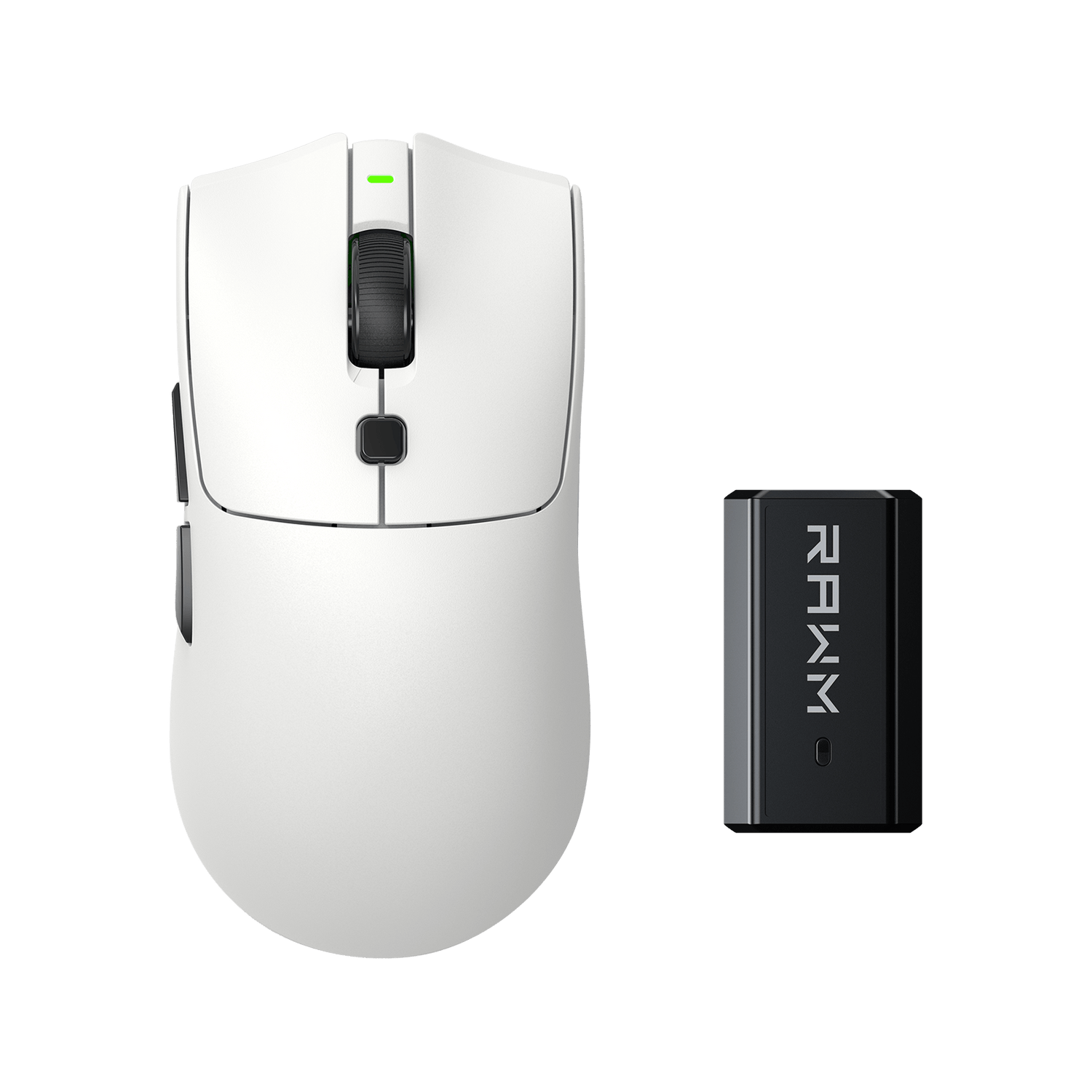
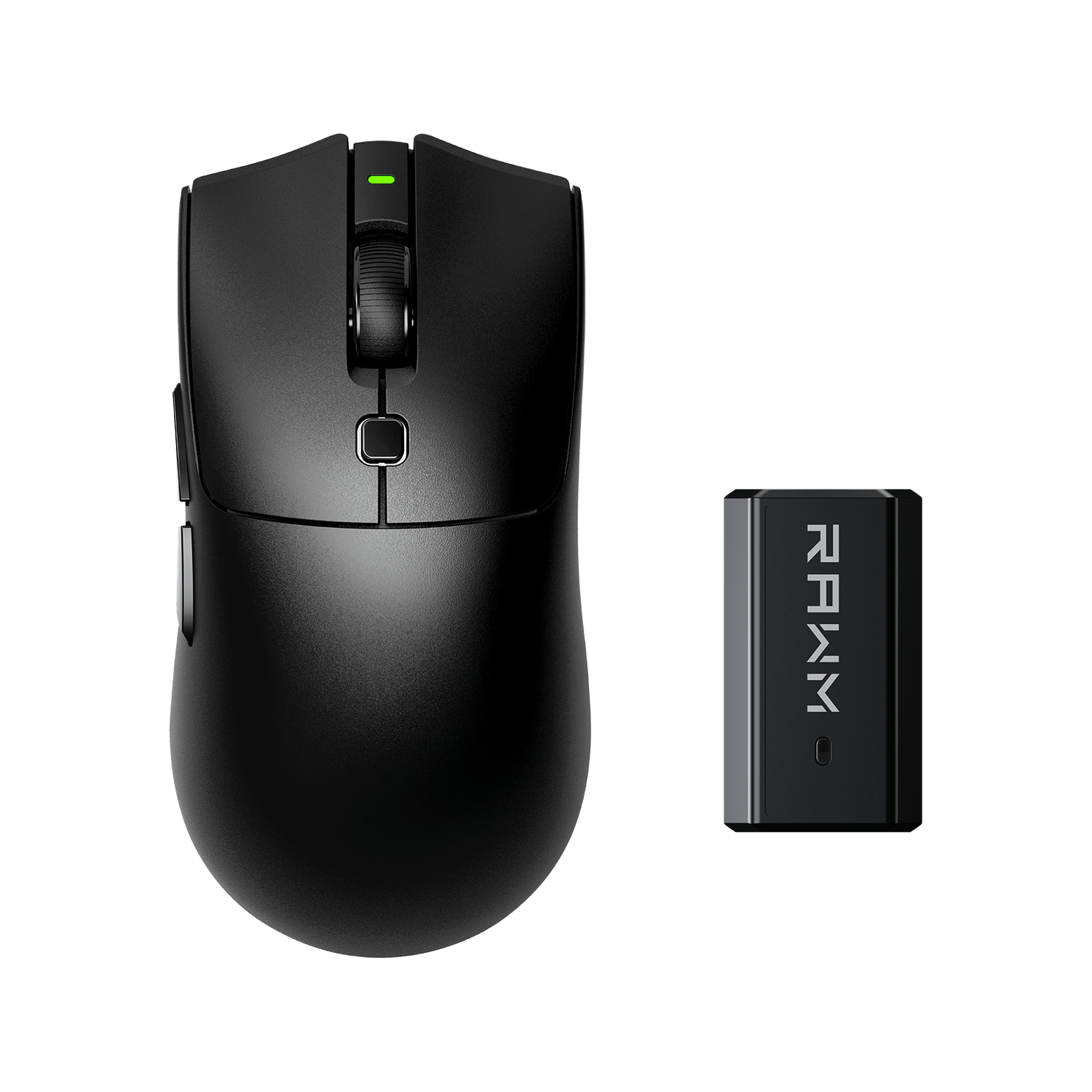
If you want an ultra-lightweight symmetrical shell built for 8000Hz hyper-polling tracking, the RAWM Leviathan V4 Wireless Gaming Mouse is armed with the next-gen Nordic 54L15 chip and PixArt PAW3950 sensor for exactly that. If you prefer an asymmetric ergonomic shape for claw or palm grip but still want pixel-perfect accuracy from a flagship PixArt PAW3950 sensor, the RAWM ER21PRO Ergonomic Gaming Mouse packed with the rock-solid Nordic 52840 MCU gives you that ideal lag-free 8K upgrade.
Click Here to View Our Full Wireless Mouse Collection and Claim Your 10% Off New-Customer Code.